Your next customer will not type. Their AI will.
Why a well written message can hide a vulnerable customer
Customer vulnerability does not disappear when a customer uses AI to write to you. The bereavement, the diagnosis and the missed premium are all still there. What disappears are the cues your team used to notice: the rambling sentences, the repeated questions, the apology for not being good with this sort of thing.
That matters for every life insurer and protection provider, because the duty to identify vulnerable customers and act on their needs under the Consumer Duty has not moved. Isara, a conversation intelligence platform, helps compliance and customer leaders meet that duty by reading the whole history of every customer conversation, rather than judging a customer on how well written their latest message looks.
The shift is already visible. The Financial Ombudsman Service is now calling more consumers to find the real issue underneath long, AI drafted complaints. If the ombudsman needs a conversation to see past the polish, so does any firm with a vulnerable customer on the other side of the inbox.
In short:
- AI helps vulnerable customers write clearly, but it removes the cues staff rely on to spot vulnerability.
- The FCA still expects firms to identify vulnerable customers and act on what their data shows.
- The answer is to judge vulnerability on a customer's whole conversation history, not on the latest message.
What the FCA and the Financial Ombudsman Service said in 2026 about AI and vulnerable customers
Customers now use AI to write to firms, the ombudsman sees both the benefit and the cost, and the FCA keeps finding that firms struggle to show how they identify vulnerable customers. Put together, those three facts create a gap that most quality assurance processes were never designed to close.
How many complaints are now written with AI?
The numbers from the ombudsman are striking. As Insurance Business UK reported on 27 October 2026:
- In a small sample reviewed earlier in 2026, up to a third of responses to the ombudsman's initial assessments appeared AI generated or heavily AI assisted.
- In the most striking case seen by the Chief Ombudsman, 37 of 39 references in a consumer's submission were wrong.
- His concern is that AI written complaints can bury the real issue under irrelevant material, which is why the service now picks up the phone more often.
Does AI help vulnerable customers?
Often, yes, and this is not a story about bad actors. The ombudsman has said that AI, used appropriately, can help vulnerable and neurodivergent consumers explain their complaints more clearly, as Which? reported on 15 May 2026.
For a customer who is grieving, unwell or anxious about money, a tool that turns a painful experience into a clear letter removes a real barrier. So the answer is not to discourage AI use or to treat polished messages with suspicion. The answer is to stop treating fluency as a sign of resilience.
What does the FCA expect on identifying vulnerable customers?
The FCA expects identification backed by data, not anecdote, and has returned to vulnerability several times in the last six months:
- July 2026, products and services review. After surveying 38 firms across seven sectors, including insurance, the FCA found firms were not clearly demonstrating how they support the needs of vulnerable customers, and named identification as an area to improve. It also reminded firms they must "act in good faith and take appropriate action on potential harm identified in their MI" (Mortgage Solutions, Professional Adviser, 10 July 2026).
- September 2026, payments firms review. Good practice meant using data and behavioural indicators to identify vulnerability. Weak practice meant overreliance on staff judgement, inconsistent recording and anecdotal examples in place of trend analysis (Regulation Tomorrow, 17 September 2026).
- May 2026, bereavement review. The FCA began examining how investment firms support bereaved customers, citing research that only 47 percent felt they received the support they needed (Mondo Visione, 13 May 2026).
- July 2026, the Mills Review. The FCA's review of AI in retail financial services, published on 6 July, advises firms to monitor Consumer Duty outcomes continuously once AI is in use (Skadden, 21 July 2026).
Underneath all of this sits the FCA's guidance on the fair treatment of vulnerable customers, FG21/1. It defines a vulnerable customer as someone who, due to their personal circumstances, is especially susceptible to harm, particularly when a firm is not acting with appropriate levels of care. It still expects firms to understand the drivers of vulnerability (health, life events, resilience and capability) and to act on them. For how the Consumer Duty applies to AI agents themselves, see our guide to FCA Consumer Duty in the age of agents.
Why does staff judgement miss vulnerability in AI written messages?
The September review warned against overreliance on staff judgement, and AI polish is exactly what defeats it. An agent reading a calm, structured and well referenced message has no reason to slow down. The tone says capable. The history may say otherwise.
Isara is built to close the gap between a polished message and a customer's real circumstances. It reviews bereavement, illness, financial difficulty and confusion indicators across every conversation, not the 1 to 2 percent a QA team typically reaches by hand. That includes customers who never use the word vulnerable.
Read the history, not the handwriting: how to spot vulnerability in AI written messages
Our view is simple. Polished first contact is becoming normal, so vulnerability identification has to move from the single message to the whole relationship. A firm that judges each message on its own will see a growing number of capable sounding customers, and miss a growing number who are struggling. It is part of a wider shift in which customers bring their own AI to the conversation.
Where does vulnerability still show in an AI written message?
AI changes how a customer writes. It does not change what is happening to them. Vulnerability leaves traces in three places that polish cannot remove:
- What survives the polish. AI tidies the wording, but it keeps the facts the customer wants you to know: a death in the family, a hospital stay, a drop in income, a request to pause premiums, a message sent on behalf of someone else. These map directly to the FCA's drivers of health, life events, resilience and capability.
- What changes over time. One message is a snapshot. A sequence shows a direction: contacts becoming more frequent, a simple policy question turning into a request to reduce cover, frustration rising across several conversations.
- What does not match. A fluent complaint followed by a confused reply in live chat. The same question asked again after it was answered. These mismatches often point to capability needs, and they only appear when contacts are read together.
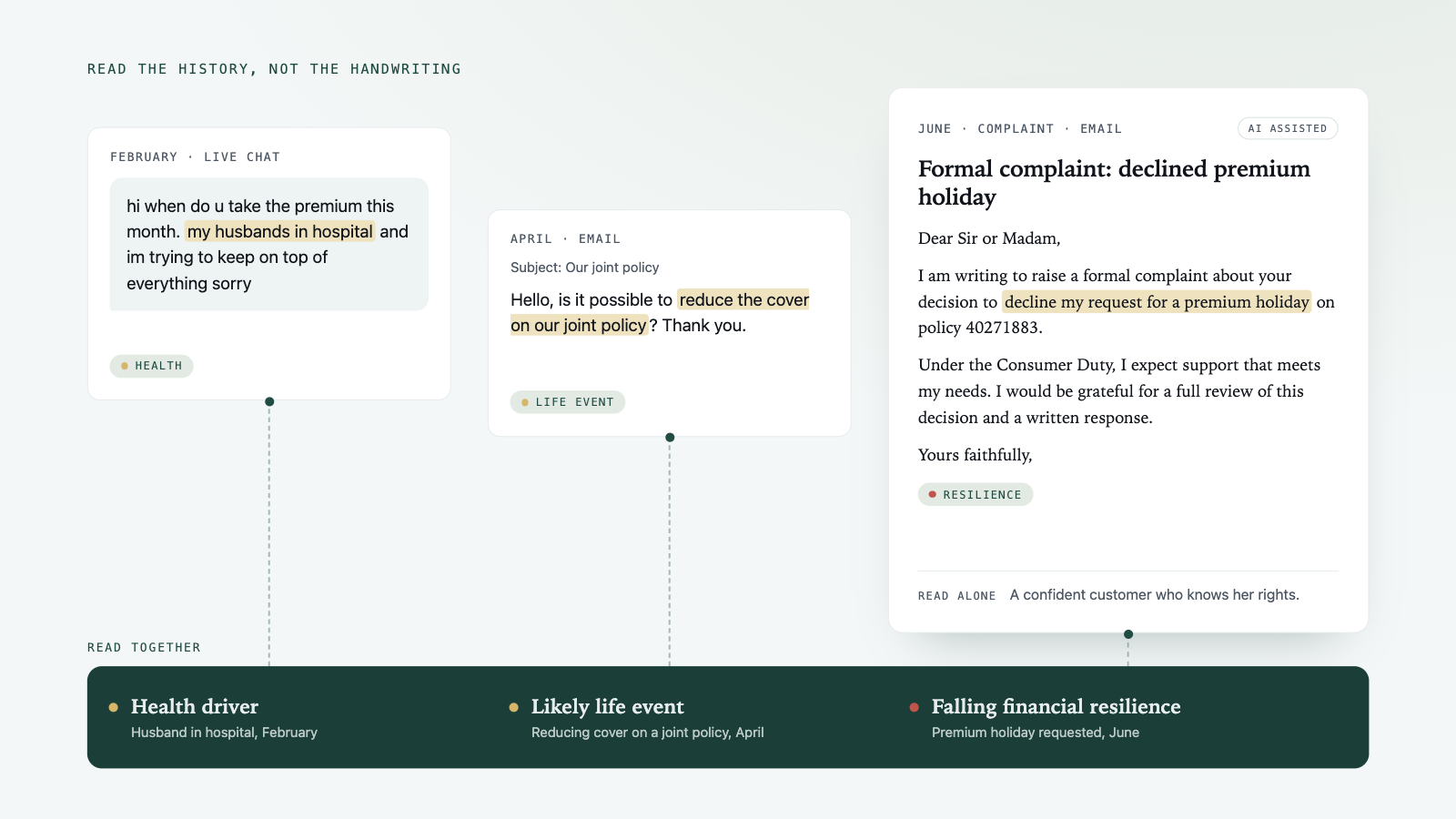
Example: a life insurance customer across three contacts
The journey below is hypothetical, but it reflects patterns life and protection teams will recognise.
- February, live chat. Short messages with typos. The customer asks when her premium is collected and mentions that her husband is in hospital.
- April, email. She asks whether she can reduce the cover on their joint policy.
- June, complaint. A two page letter, clearly AI assisted, about a declined premium holiday. It is calm, well structured and quotes the Consumer Duty.
Read alone, the June letter describes a confident customer who knows her rights. Read with February and April, it shows a health driver, a likely life event and falling financial resilience. A complaint handler who sees only June will answer the argument. A firm that sees the history will answer the person.
Four changes for life insurance compliance leaders
- Treat fluency as neutral. A well written message is neither a red flag nor a reassurance.
- Move from message level QA to customer level review. Vulnerability is a property of the customer's situation, not of one email.
- Report trends, not anecdotes. Boards need to see how many customers showed vulnerability indicators, how many were flagged and how many received an adapted outcome.
- Do not chase AI detection. It looks at the tool rather than the customer's needs, and penalising AI use would hurt the very customers it helps most.
Isara works at the customer level in the same way. It does not try to work out who or what wrote a message. It reads what customers said across all their conversations and surfaces the indicators that point to vulnerability, with the transcript linked to each one.
Frequently asked questions: Isara and vulnerable customers
Does Isara detect whether a customer used AI to write a message?
No. Isara does not try to detect AI written text, and it does not need to. It reads what the customer actually said across every conversation, so a vulnerability indicator is surfaced whether the message was typed in a hurry or polished by an assistant.
Which vulnerability indicators does Isara look for?
Isara reviews bereavement, illness, financial difficulty and confusion indicators across every conversation. It also picks up customers who describe their situation without ever using the word vulnerable, which is how most people talk.
How does Isara show change over time, not just one message?
Isara's Customer Frustration Watch tracks how frustration evolves across a customer's conversations, and Escalation and Early Warning Signals highlight heated exchanges before they escalate. Together they show the direction of travel that a single polished complaint hides.
Can Isara check how our AI agent handles vulnerable customers?
Yes. Isara's AI Agents Focus flags vulnerability signals that were present in a conversation but not escalated, whether a human or an AI agent handled it. Each flag links to the transcript, so your team can see exactly what was missed.
How does this help with Consumer Duty board reporting?
Isara turns individual flags into patterns across your whole customer base, which gives boards trend analysis rather than anecdotes. Compliance Audits adds a review of every conversation against the frameworks you choose, with the evidence attached.
What is Isara building next for vulnerability oversight?
Isara's Agent and CSM Performance capability, now in development, will show how consistently each team member surfaces risks and escalates critical issues. For vulnerability, that means seeing not only which customers needed help, but whether your people recognised it.