Your next customer will not type. Their AI will.
Your next customer will not type. Their AI will.
What happens when your customer sends an AI instead of typing?
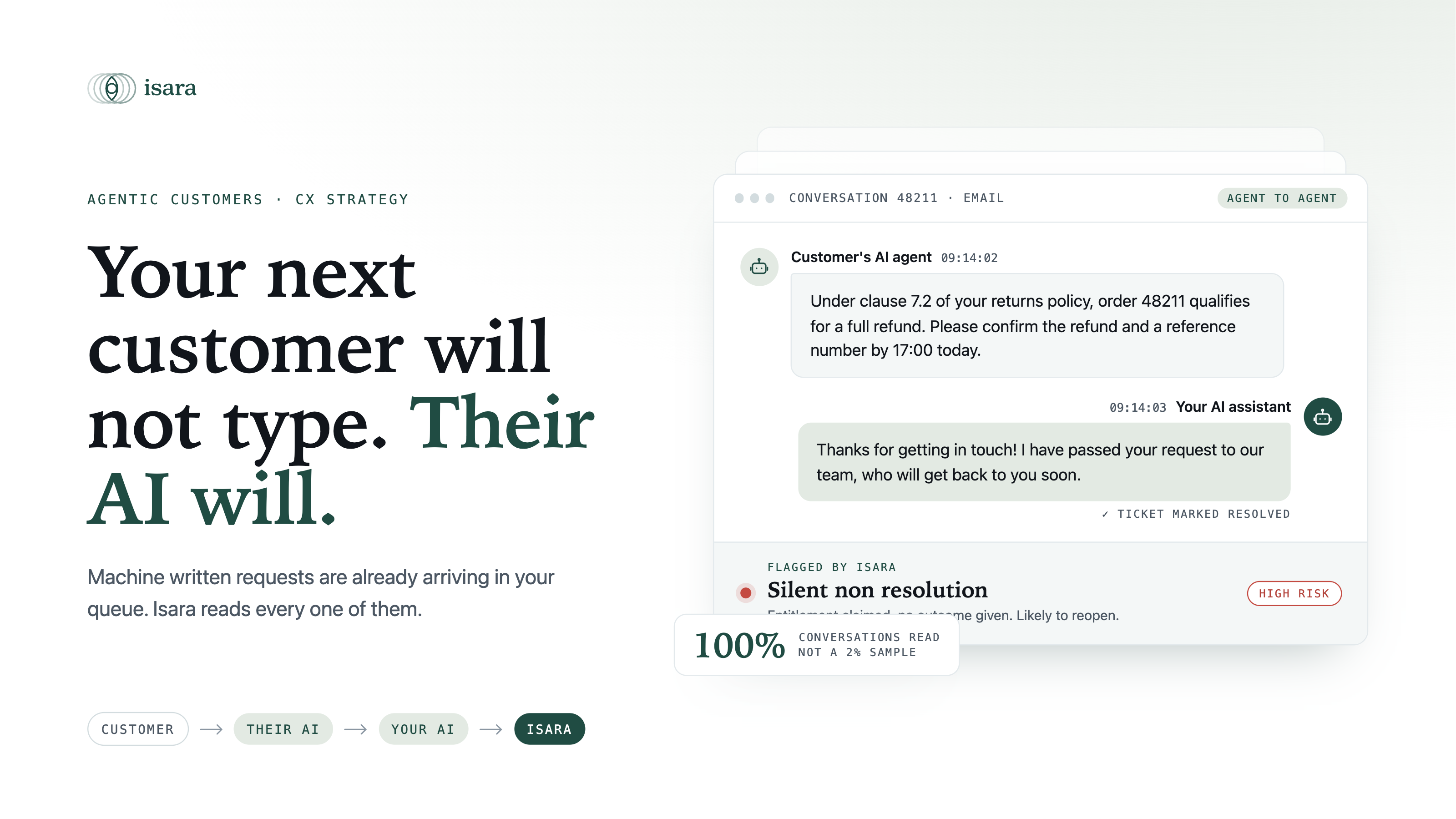
More and more of your customers are no longer typing their own messages. They are handing the task to an AI agent that shops, complains, negotiates and chases resolutions for them. The message that lands in your queue was written by software, and it is often read and judged by software before a person is ever involved. Isara was built for this shift, because once conversations become machine to machine, the only reliable way to know what happened is to read all of them rather than a sample.
An agentic customer is a person who hands a buying or service task to an autonomous AI agent, which then discovers, purchases, complains or resolves on their behalf.
Key takeaways for CX leaders:
- Customers are starting to delegate service and shopping tasks to AI agents, so your support is often read by a machine before a person sees it.
- Gartner found in August 2026 that 58% of people who used AI for a service task let it complete the task for them.
- Expect interaction volume to rise, and each interaction to become faster, more precise and less forgiving.
- The costly failures in automated conversations are silent rather than loud, which is exactly what quality sampling misses.
- Isara reads 100% of customer conversations across major helpdesks to surface AI agent failures, compliance exposure and churn risk.
The shift is real but uneven. The same Gartner research found customers were roughly three times more likely to use a third party AI service than a company's own chatbot during their most recent interaction. The experience you design for a person is increasingly received by an agent first, so clarity, consistency and auditability now matter as much as tone.
How common are agentic customers in 2026?
Agentic customers already exist in two forms, and both are live today.
On the buying side, autonomous shopping agents discover, compare and sometimes purchase for a person. Consumer facing agents in market during 2026 include ChatGPT with Instant Checkout, Perplexity's Comet browser, Amazon's Rufus and Google's AI Mode shopping. Juniper Research, in an April 2026 forecast, projected around 8 billion dollars of agentic spend in 2026, rising towards 1.5 trillion globally by 2030.
On the service side, the delegation is sharper. Pine AI, for example, is a consumer agent that calls customer service, negotiates bills, cancels subscriptions, files complaints and chases refunds for its users. The company reports a 93% success rate on negotiations. Treat that as a vendor claim rather than independent data, but the direction is unmistakable. Anyone can now point an agent at your contact centre and walk away.
Your own side is automating at the same pace. Salesforce data shows AI agent adoption in customer service rising from 39% to 66% in a single year. A Cisco survey of 7,950 decision makers across 30 countries, reported in 2026, projected that 56% of service interactions with technology vendors would move to agentic AI within twelve months.
So the honest picture is two automated parties meeting in the middle. Isara reads conversations wherever they arrive, across Zendesk, Freshdesk, Intercom, HubSpot, Front and Gorgias, which is where this machine written traffic surfaces first.
A note of realism, because the hype runs ahead of the behaviour. Gartner found in May 2026 that willingness to let AI make an actual purchase decision topped out at just 11% in low stakes categories. In a separate August 2026 survey, 87% of customers said access to a human remained essential. Delegation is rising fastest for chores such as chasing a refund, not for high trust decisions. Prepare now, but do not assume full autonomy has arrived.
How will agentic customers change the volume and nature of your interactions?
In two ways at once. The number of interactions is likely to rise sharply, and the character of each one changes when the party on the other end is tireless, precise and optimising for an outcome.
Start with volume. For a person, contacting support has always carried a cost: the hold music, the repeated details, the lost time. That cost is what kept a great many small grievances from ever reaching you. Agentic customers remove it. When someone can hand off the chore and walk away, the friction that quietly suppressed contact disappears, and issues that used to be swallowed in silence now arrive as actioned requests.
The behaviour behind this is already measurable. Gartner found in August 2026 that 58% of people who used AI for a service task let it complete the task for them, and that customers were roughly three times more likely to reach for a third party AI service than a company's own channel. Zendesk's chief executive has gone further, publicly describing a future in which every customer interaction involves AI in some form. That last point is a leader's opinion rather than a measured figure, but the direction is hard to argue with. Plan for more conversations, not fewer, even as your own automation deflects a growing share of them.
Now the harder half. These conversations are different, because an AI acting for a customer does not behave the way the customer would.
- It is tireless. It does not forget, tire, or accept a first no, so cases stay open and get reopened until the stated goal is met.
- It is precise and policy literate. It names the outcome it wants and the entitlement it is claiming, quotes your own terms back to you, and struggles with the vague or templated replies that would have satisfied a person.
- It optimises relentlessly. It finds the weakest point in a policy and returns to it, which turns one loose refund rule into a repeatable result rather than a one off.
- It acts in parallel. It can contact you and three competitors in the same minute, so your answer is benchmarked in real time against everyone else's.
The combined effect is more contacts, each one faster, sharper and less forgiving than its human equivalent. The comfortable metrics of the old world, such as average handle time or a tidy containment rate, describe a conversation that is starting to disappear.
This is where reading everything stops being a luxury. Isara reviews 100% of these conversations, so a jump in volume and a shift in behaviour show up as evidence you can act on, rather than as a slow and unexplained rise in cost and churn.
Why conversation sampling fails once customers use AI agents
That shift, more conversations and sharper ones, lands squarely on your quality process, because in an automated exchange the failures that hurt you are quiet rather than loud.
Research from ChatSee, published in July 2026 across more than 10,000 observed enterprise AI failure events, found that hallucinations now account for less than 10% of failures. The larger categories were resolution and escalation breakdowns, at around 31%, with execution and action failures up 62% against a 2024 baseline. In plain terms, the AI sounds polite, looks helpful, and quietly fails to resolve the issue. A courteous non answer raises no alert.
A silent non resolution is the real danger. The agent sounds polite, the ticket looks closed, and nothing flags. At human volumes you might still catch it by eye in a sample. At agentic volumes you will not, because the problems cluster around the exact policy weak points that agents probe hardest, which are the least likely to turn up in a random 2%.
Consider a simple and clearly hypothetical model. An operator handles 50,000 conversations a month and reviews 2% for quality, the common industry norm. That is 1,000 conversations seen and 49,000 unseen. If even a small share of the unseen set hides a silent non resolution or a compliance exposure, sampling will report that all is well while the risk compounds. Quality assurance by sampling was already generous to the business. In an agentic world, where problems cluster around consistently probed weak points, it breaks.
This is the heart of the argument. You cannot manage what you only sample. Isara reads 100% of conversations, not only support tickets but any conversation type, and surfaces churn risk, compliance exposure, agent performance problems and AI agent failures across the whole estate. These failures are systemic and operational, a matter of context, policy and escalation design rather than any single model being weak, which is why they have to be observed in the conversation itself.
Agentic customers and Isara: frequently asked questions
What is an agentic customer?
An agentic customer delegates a buying or service task to an autonomous AI agent that acts on their behalf. For your team it means more of your inbound conversations are written, and sometimes spoken, by software. Isara reads every one of these conversations across Zendesk, Freshdesk, Intercom, HubSpot, Front and Gorgias, so machine written messages are analysed on the same footing as human ones.
How does Isara help when customers use AI agents to contact us?
Isara reviews 100% of conversations rather than a sample, whoever or whatever wrote them. That full coverage is what lets you understand behaviour you have never seen before, such as agents probing policies or reopening cases at speed.
Can Isara detect when an AI agent has failed silently?
Yes, that is a primary use case. Isara is designed to surface the quiet failures that never trigger an alert, including AI agent failures and resolution breakdowns, so your team sees the polite non answers and inconsistent responses that sampling misses.
How does Isara help regulated businesses such as iGaming and fintech?
Isara monitors every conversation for compliance exposure, which is built for the regulated markets it serves. When both parties are automated and volume rises, full coverage rather than spot checks gives compliance teams defensible evidence of what was said and promised.
Does Isara only read support tickets?
No. Isara reads 100% of customer conversations, not only support, which matters because agentic buyers and agentic complainants appear across sales, billing and service at once rather than in one tidy queue.
How does Isara surface churn risk in automated conversations?
Isara reads churn risk signals from the conversations themselves, and Ask Isara lets teams query that body of conversations in plain language instead of waiting on a dashboard. As agent to agent exchanges grow, Isara is focused on extending this visibility to the automated interactions now entering the queue.