You do not need a data team to see what your agents are doing
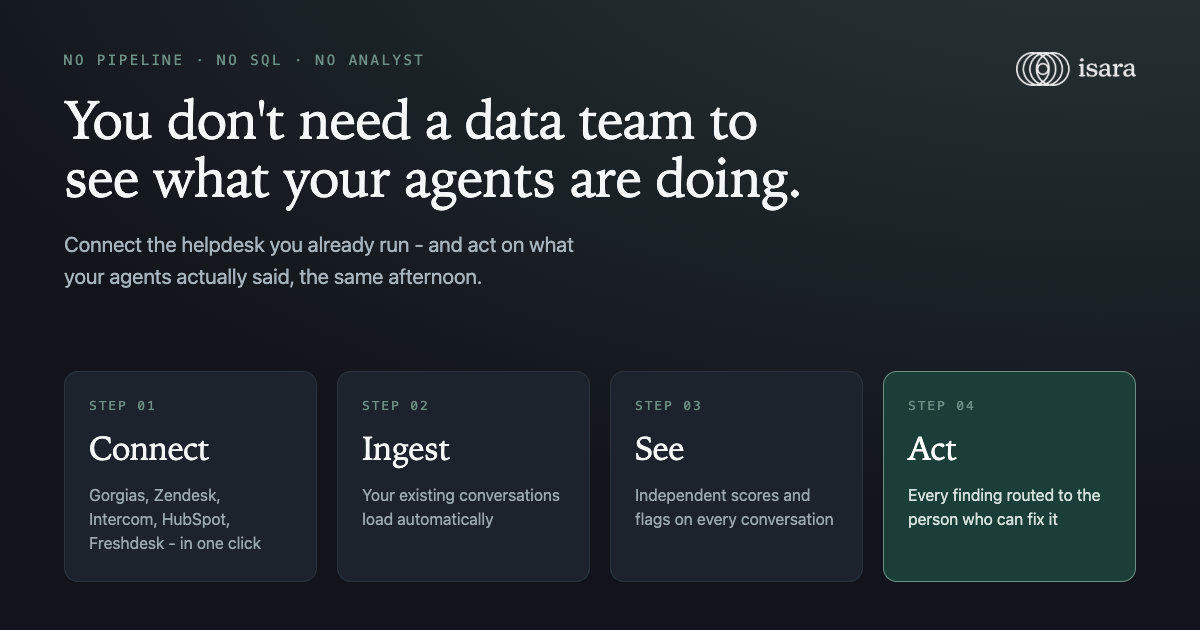
Quick answer: You do not need a data team to see what your AI agents are doing. Modern AI agent monitoring connects straight to the helpdesk you already run, ingests your conversations automatically, and turns them into clear insights within hours. Isara does exactly this. It connects in one click to tools like Gorgias, HubSpot, Intercom, Zendesk and Freshdesk, then reads every AI and human conversation, so a lean team gets independent oversight without hiring an analyst or building a data pipeline.
Key takeaways
- Agent visibility is now an operational requirement, not a data science project reserved for large enterprises.
- For most lean teams the blocker was never the technology. It was setup effort, engineering time, and headcount.
- Independent AI agent monitoring that connects in minutes lets any support or success team see what its agents actually do.
Key statistics at a glance
- Gartner projected in May 2026 that 40 percent of organizations deploying AI will use AI observability tools by 2028 to monitor performance, bias and outputs.
- 2026 customer service data shows only 15 percent of teams have no plans to adopt AI, down from 38 percent in 2022, so almost every team now runs agents worth watching.
- In 2026 roughly 64 percent of enterprise customer experience teams ran an agentic AI pilot, yet only about 27 percent had at least one channel in full production, a gap often tied to limited oversight and resources.
- In 2026, no code support platforms report connecting to a helpdesk in minutes and reaching value in under a day, evidence that meaningful oversight no longer requires engineering or an analyst.
Agent Visibility Is No Longer a Data Science Project
You do not need a data team to see what your AI agents are doing. For years, understanding your own support conversations meant exporting data, wiring up a warehouse, and waiting for an analyst who was already busy. That barrier is gone. Isara was built so that a lean support or success team can connect the helpdesk it already uses and start seeing what its agents say to customers within hours, with no pipeline, no SQL, and no dedicated analyst.
For customer support and customer success leaders, this shift matters more than it sounds. As AI agents take on more of your frontline conversations, the question is no longer whether to monitor them. It is whether monitoring is fast and simple enough that a small team can actually do it. The good news is that the setup cost that used to lock smaller teams out has collapsed.
Why Lean Support Teams Have Been Locked Out of Agent Monitoring
Agent monitoring, sometimes called AI agent observability, is the practice of independently checking what your automated and human agents tell customers, so you can catch inaccurate answers, off policy promises, and frustrated customers before they escalate. Gartner described this discipline in May 2026 as a growing priority, projecting that 40 percent of organizations deploying AI will use AI observability tools by 2028. As one Gartner analyst put it, the visibility gap is what makes scaling AI risky.
The old way was built for teams with engineers to spare
Traditional analytics assumed you had people and time. The typical path looked like this:
- Export tickets and transcripts from every channel by hand or through custom scripts.
- Stand up a warehouse and a set of dashboards, usually with engineering help.
- Wait for a data analyst to write queries and interpret the results.
- Discover a problem weeks after it happened, long after the customer moved on.
For a small team, each of those steps was a reason to give up. This is not a niche problem. Skilled analysts are scarce and expensive, so even teams that wanted one often could not staff the work fast enough. Meanwhile adoption kept climbing. In 2026, only 15 percent of customer service teams reported no plans to adopt AI, down from 38 percent in 2022, which means almost every team now runs agents that deserve a closer look.
The result: pilots that stall for lack of oversight
The gap between trying AI and trusting it in production is where many teams get stuck. In 2026, roughly 64 percent of enterprise customer experience teams ran an agentic AI pilot, yet only about 27 percent had moved at least one channel into full production. A common reason is simple. Leaders cannot prove what the agent is doing at scale, so they hesitate to hand it real volume. Independent visibility is what turns a nervous pilot into a confident rollout.
The new way connects to what you already run
Modern tools flip the model. Instead of asking a team to build infrastructure, they connect directly to the helpdesk in place and read the conversations that already exist. Isara is built for exactly this reality. It connects in one click to Gorgias, HubSpot, Intercom, Zendesk and Freshdesk, ingests your conversations automatically, and surfaces insights within hours. There is no export, no warehouse, and no analyst required. A support lead can set it up in the morning and review what the agents actually said by the afternoon.
The Visibility Tax: What Every Hour Without Agent Oversight Really Costs
Here is a way to frame the problem that lean teams rarely name out loud. Every hour an agent runs without independent oversight carries what we can call a visibility tax. It is the quiet cost of not knowing: the wrong answers you never see, the off policy promises nobody flags, and the frustrated customers who leave without filing a complaint. Because it never shows up as a line item, it is easy to ignore until it surfaces as churn or a dispute.
Consider an illustrative scenario, using round numbers for clarity rather than any specific customer. Imagine a lean team whose AI agent handles 20,000 conversations a month. If even 5 percent contain an answer the business would not stand behind, that is 1,000 conversations a month, or 12,000 a year, where something went wrong and nobody looked. A team without monitoring pays that tax in full and never sees the invoice. A team that connects monitoring in an afternoon starts paying it down the same day. This model is hypothetical and meant to show scale, not to predict any single team's numbers.
A simple four step path from blind spot to oversight
The fastest way to think about closing the gap, with no data team involved, is four steps:
- Connect: link the helpdesk you already use in one click, with no engineering ticket.
- Ingest: let your existing conversations load automatically, rather than exporting them by hand.
- See: get independent scores and flags on every conversation within hours, not weeks.
- Act: route each finding to the person who can fix the document, the product, or the agent configuration.
Isara is designed to make all four steps take minutes rather than months. Because it reads every conversation instead of a sample, a lean team gets the same depth of oversight that used to require a dedicated analytics function. The prediction worth making for the year ahead is straightforward. As agents take on more frontline work, the teams that make monitoring effortless will scale AI with confidence, while the teams still waiting on a data project will keep flying blind.
Isara FAQ: Monitoring Your Agents Without a Data Team
Short answers to the questions support and success leaders ask after reading this article about seeing what your agents are doing without a data team.
Do I really need a data team to monitor my AI agents with Isara?
No. As this article explains, Isara removes the data team from the equation. It connects in one click to tools like Gorgias, HubSpot, Intercom, Zendesk and Freshdesk, ingests your conversations automatically, and produces insights within hours, so a lean team gets oversight without a pipeline or an analyst.
How fast can a small team actually get started?
Fast. The whole point of the accessible approach described above is speed. Isara auto ingests your existing conversations after a one click connection, so you can set it up in the morning and review what your agents said to customers the same day, rather than waiting weeks for a data project.
What does Isara show me once it is connected?
Isara reads every AI and human conversation, not just a survey sample, and scores them so you can see inaccurate answers, inconsistencies, off policy promises, and signs of customer frustration. Each finding ties back to the exact conversation, which turns the visibility tax described in this article into a specific, evidenced list you can act on.
Will it work with the tools we already use?
Yes. Isara is built to sit on top of your current stack with one click connections to Gorgias, HubSpot, Intercom, Zendesk and Freshdesk, and it runs independently of the agent it is watching. That independence is what lets it flag problems your agent platform has no reason to report on itself.
We are a small team now, but what happens as we grow?
Isara is designed to scale with you. The same one click monitoring that helps a lean team today extends into real time oversight, unified scoring for mixed human and AI teams, and upcoming compliance and audit capabilities as your volume and requirements grow, so the setup you do this week keeps paying off as your agents take on more.