The AI Agent Is the Only Agent Nobody Manages
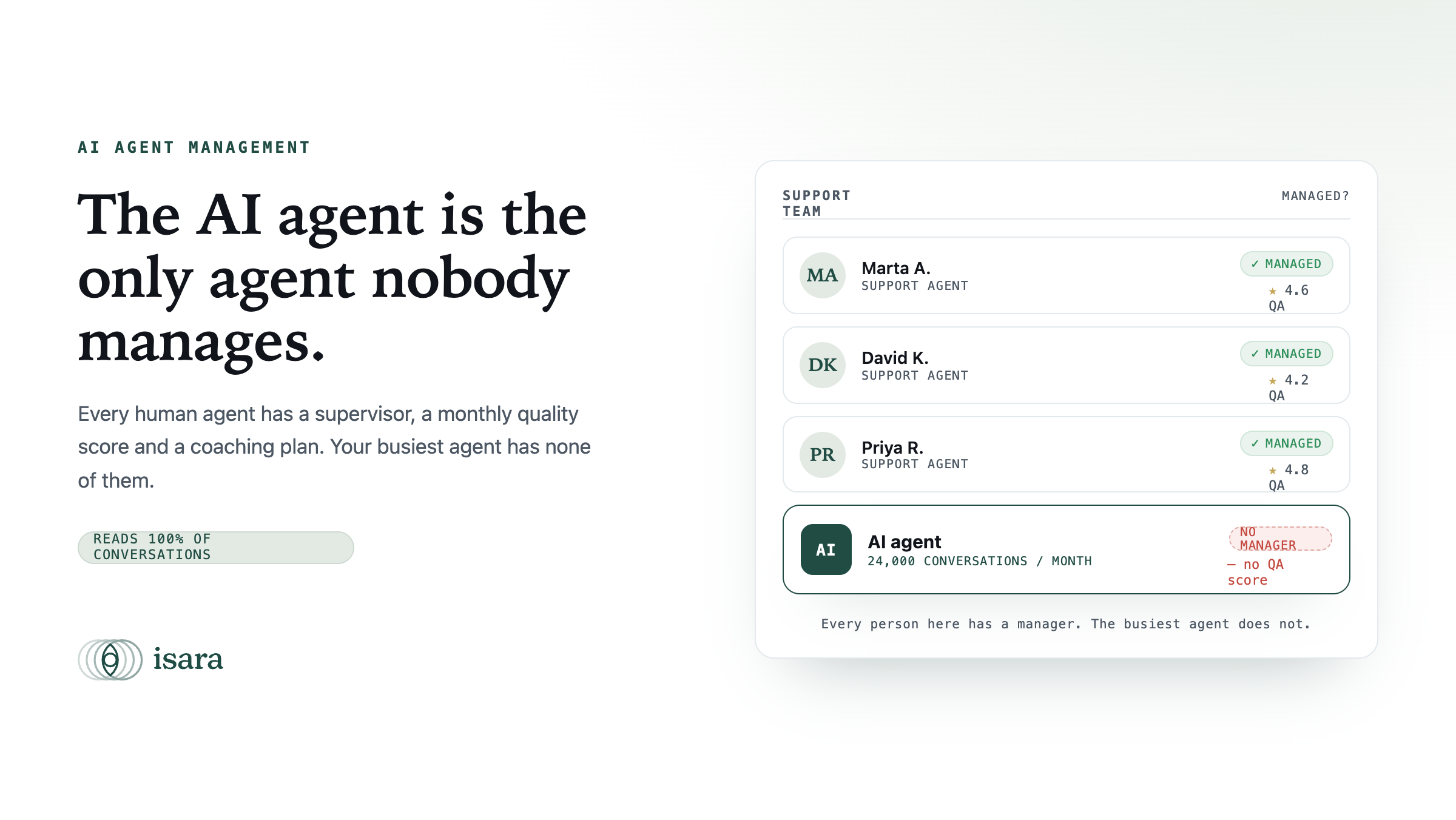
AI agent management is the practice of applying the same oversight to an AI support agent that an organisation already applies to a human one: a named owner, a quality score, a review cadence, a coaching loop and a sign off process when something fails. Most customer service organisations have not built it. Every human agent in a support team has a line manager, a monthly quality score and someone accountable when a conversation goes wrong. The AI agent handles more conversations than any of them and has none of those things. Isara closes that gap by reading 100% of customer conversations rather than a sample, so AI agent behaviour becomes something an organisation can evidence rather than infer.
Key takeaways
- AI agent failures are rarely a model capability problem. They are an oversight problem.
- Ada and NewtonX research published in March 2026 found that 44% of businesses have no visibility into AI agent performance.
- Manual quality assurance in customer service typically covers 1 to 5% of tickets, a sampling rate designed for a workforce that also had supervisors.
- The AI conversations least likely to be reviewed are the ones the AI closed confidently, which is also where liability is created.
- Isara applies quality scoring, compliance auditing and consistency checks across every conversation, separating AI handled from human handled interactions.
What the 2026 Data Says About AI Agent Oversight in Customer Service
The oversight gap in AI customer service is now measurable, and the research published in 2026 is consistent across independent sources.
Research published by Ada and NewtonX on 23 March 2026, covering 2,000 consumers and 500 enterprise customer experience and AI leaders across three continents, found that 44% of businesses have no visibility into AI agent performance.
The same Ada and NewtonX research found that 44% of businesses measure AI and human agent interactions together. Measuring both populations as one number means an organisation cannot pinpoint where AI is falling short, establish a credible return on investment baseline, or systematically improve performance.
AI agent oversight is also a staffing problem. In the same March 2026 research, 29% of customer experience leaders said their team is not adequately resourced and skilled to manage, audit and coach AI agents effectively.
Volume through these agents continues to rise. Salesforce State of Service research reported in September 2026 shows AI agent adoption in customer service climbing from 39% in 2025 to 66% in 2026.
Unmanaged AI agents get switched off. Sinch published The AI Production Paradox on 13 May 2026, based on an independent survey of 2,527 senior decision makers across ten countries and six industries, with fieldwork conducted between January and February 2026. The study found that 74% of enterprises have already rolled back or shut down an AI customer communications agent after deployment due to a governance failure, rising to 81% among organisations with fully mature guardrails. Among the stated reasons for pulling an agent, 16% cited a lack of auditability.
The pattern extends beyond customer service. The Agents Without Guardrails report from Enterprise Management Associates, published on 1 September 2026 and based on 202 enterprise technology and security leaders, found that AI agents acted outside their intended scope at 65% of surveyed enterprises, with 29% reporting measurable organisational impact.
Set those figures against how quality assurance actually operates. Industry benchmarks cited throughout 2026 place manual quality review coverage at 1 to 5% of tickets, leaving 95 to 99% of conversations unreviewed. A 2% sample was already thin when every conversation belonged to a person with a supervisor. Applied to an agent that has no supervisor at all, a 2% sample provides almost no assurance.
Analysts have named the ownership question directly. Writing about Forrester's assessment of the customer service market in April 2026, Kate Leggett described the inversion: AI addresses the majority of the work, while customer service representatives assist AI. The organisational questions that follow are who owns AI outcomes, who owns customer harm when automation fails, and who updates policy and knowledge when the business changes.
Regulators have reached the same conclusion. FINRA's 2026 Annual Regulatory Oversight Report flagged hallucinations as a specific compliance concern for broker dealers and warned firms to develop procedures for AI agents that may act beyond the user's intended scope. Across recent cases the position is consistent: when an invented answer concerns a company's pricing, policy or refund terms, courts, regulators and insurers agree that the company owns what its model said.
Isara addresses this by reading 100% of conversations across Zendesk, Freshdesk, Intercom, HubSpot, Front and Gorgias. Isara AI Agents Focus and Isara Agent Intelligence treat the AI agent the way a mature quality programme treats a person, producing a score, a failure breakdown and a record that can be shown to a regulator.
The Headcount Equivalence Test: Sizing the AI Agent Management Gap
The headcount equivalence test is a way to measure the AI agent management gap using only figures an organisation already holds. It converts AI conversation volume into human agent equivalents, then applies the organisation's existing management standards to that number.
Consider a support operation handling 40,000 conversations per month. The AI agent handles 60% of them, which is 24,000 conversations. A human agent working chat and email handles roughly 700 conversations per month. On those assumptions the AI agent performs the work of approximately 34 people.
Now apply the organisation's own management standards to 34 people.
- At a supervisor ratio of one to fifteen, 34 agents require two to three team leaders
- At four scored conversations per agent per month, 34 agents generate 136 quality reviews
- At one coaching session per agent per month, 34 agents generate 34 coaching conversations
- Each of those 34 agents receives a refresher when policy changes, and each has a named manager who signs off when something goes wrong
The AI agent receives none of that. The AI agent receives a containment rate.
The arithmetic is the argument. An organisation that would not run 34 people with no supervisor, no scoring and no coaching loop is already operating outside its own standard when it runs an AI agent at that volume.
A second problem sits inside the first, and most operations miss it.
The AI conversations most likely to be reviewed are escalations. Somebody looks at escalations because a human picked the conversation up, or because a customer complained. The AI conversations least likely to be reviewed are the ones the AI closed quickly and confidently, with a customer who appeared satisfied.
Confident and wrong is the failure mode that costs money. An AI agent that hands over when it is unsure is behaving correctly. An AI agent that invents a refund window and closes the ticket creates the liability, and that conversation is the one a review process is structurally least likely to see.
Reviewing escalations is not quality assurance of an AI agent. Reviewing escalations is quality assurance of handover logic.
Isara predicts that this reverses during 2027. The reporting line for AI agents will move from whoever built the agent to whoever owns the customer outcome, and quality programmes will be judged on coverage rather than sample size. Isara Compliance Audits and the Isara Inconsistencies metric are built for that shift, because the operative question moves from whether the AI answered quickly to whether the AI answered the same way twice.
Frequently Asked Questions About Managing AI Agents With Isara
Why is containment rate not enough to manage an AI agent?
Containment measures avoidance rather than outcome. A customer who abandons the AI agent, switches channel and contacts the business again has not been helped, yet the containment figure still looks healthy. Isara reads the full conversation rather than the closing metric, and Isara Predicted CSAT scores every interaction rather than only the small share of conversations where a customer completes a survey.
How does Isara score an AI agent when there is nobody to coach?
Isara AI Agents Focus applies the same quality logic an organisation uses for people, across every conversation rather than a sample. Isara Agent Intelligence separates AI handled interactions from human handled interactions, so a customer experience leader can identify which population caused a change in performance instead of reading a blended figure that conceals both.
How does Isara catch an AI answer that was confidently wrong and never escalated?
Through the Isara Inconsistencies metric. When an AI agent gives two different answers to the same policy question across different customers, Isara surfaces that pattern even when both conversations closed successfully and neither was escalated. This is the failure type that sampling based quality assurance cannot reach.
What evidence can a regulated business show an auditor?
Isara Compliance Audits run across 100% of conversations and produce a record of what was said and when, rather than a sample with an inference attached. For regulated markets in iGaming, financial services and insurance, the difference between a sample and a complete record is the difference between an argument and evidence.
How quickly can a business find out whether it has an AI agent management gap?
Isara connects to Zendesk, Freshdesk, Intercom, HubSpot, Front and Gorgias through one click connectors, so the first read of an existing conversation history does not require an integration project. Isara Recommendations, delivered as AI Boosts with a hand off into Jira, convert what the audit finds into work a team can action.