When your bot gives two different answers to the same question
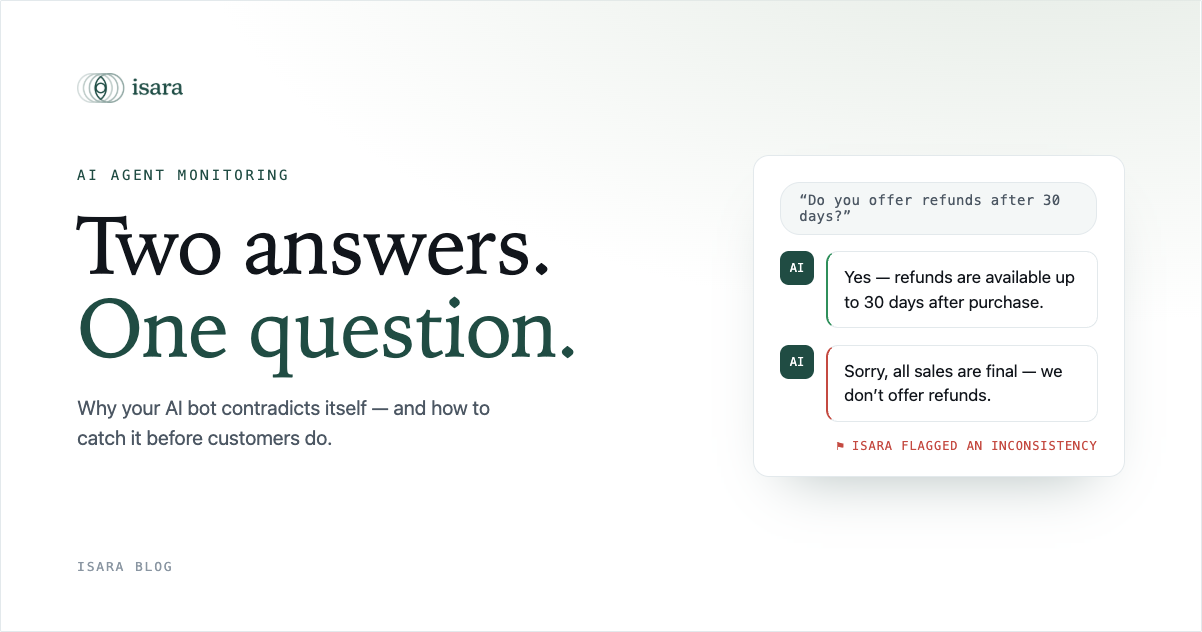
Quick answer: An AI support bot gives two different answers to the same question because it generates each reply word by word using probability, rather than retrieving one fixed answer from a database. The problem grows when the knowledge base is outdated, duplicated, or contradictory. The fix is trusted knowledge, clear guardrails, and independent monitoring, such as Isara, that reads every AI conversation and flags inconsistencies before customers lose trust.
Key takeaways
- Inconsistent answers are a predictable outcome of how generative AI works, not a rare bug.
- The real risk is reputational and financial: lost trust, disputes over what was promised, and churn.
- You cannot fix what you cannot see, so independent visibility into every AI conversation comes first.
Key statistics at a glance
- AI gave consistent answers to the same question only about 73 percent of the time, according to a March 2026 Washington State University study.
- 36 percent of customers are frustrated by inaccurate information from AI, and 49 percent are frustrated by AI that cannot answer their question, per 2026 customer experience data.
- Roughly 1 in 3 people received an incorrect calculation from AI, and 65 percent of corrected answers were still wrong, according to a 2026 study of 1,014 users.
- A 6,000 person study comparing October 2025 to April 2026 found declining trust in AI and a rising preference for human agents.
Two Answers, One Question: The Consistency Problem Support Leaders Cannot Ignore
When your bot gives two different answers to the same question, the cause is almost never a single broken setting. It is how these systems work, combined with gaps in the knowledge they draw from. Modern AI agents generate replies through probability rather than lookup, so the same question can return different wording, a different policy, or a different fact on separate attempts. Isara exists for exactly this blind spot, giving support and success leaders an independent view of what their AI actually tells customers, so contradictions surface before they reach the next person who asks.
For customer support and customer success leaders, inconsistency is not a cosmetic flaw. It quietly undermines trust, invites disputes over what was promised, and pushes at-risk accounts closer to churn. The good news is that it is measurable, explainable, and fixable once you can see it.
Why Do AI Support Bots Give Different Answers to the Same Question?
Answer inconsistency is when a support bot returns materially different responses to the same or very similar question, whether in facts, policy, or tone. It is different from a simple wrong answer, because the bot may be right on one attempt and wrong on the next, which makes it harder to catch and easier to trust by accident.
The technical cause: generation, not retrieval
A large language model does not pull a fixed answer from a database. It predicts the most likely sequence of words given the input, and the most likely sequence can shift with small changes in phrasing, context, or retrieved content. Recent testing shows how real this is. A March 2026 study from Washington State University asked ChatGPT the exact same question ten times and found consistent answers only about 73 percent of the time.
The common triggers behind inconsistent answers
- Outdated or missing content in the knowledge base, so the model fills gaps by guessing.
- Conflicting or duplicated articles that describe the same policy in different ways.
- Weak retrieval that surfaces the wrong source passage for a given question.
- Model hallucination, where the system invents a plausible but false detail.
- No feedback loop, so nobody catches the contradiction and corrects the source.
What inconsistency costs in trust and revenue
The cost lands on customers and revenue. In recent 2026 data, 36 percent of customers report frustration with inaccurate information from AI, and 49 percent are frustrated by AI that cannot answer their question at all. A separate 2026 study of 1,014 people found that roughly 1 in 3 users received an incorrect calculation from AI, and that 65 percent of the time a corrected answer was still wrong. Trust is trending in the wrong direction too: a 6,000 person study comparing October 2025 to April 2026 showed declining trust in AI, rising frustration, and a growing preference for speaking to a real person.
This is where independent oversight matters. The platform running your AI agent also reports on it, so the mistakes that never generate a complaint stay invisible. Isara sits outside that loop, reading every AI conversation to surface inaccurate answers, fabrications, off policy promises, and inconsistencies, each tied back to the exact conversation behind the finding. In practice, that turns a vague worry about bot reliability into a specific, evidenced list of where consistency broke down.
Consistency Debt: The Hidden Cost of a Bot That Cannot Keep Its Story Straight
Here is a way to think about the problem that most teams miss. Every contradiction your bot produces creates what we can call consistency debt: a small, compounding liability made of confused customers, contradicted promises, and support tickets that reopen because the answer changed. Like technical debt, it is invisible until the interest comes due as a dispute, a chargeback, or a cancelled renewal.
Consider an illustrative scenario, using round numbers for clarity rather than a specific customer. Imagine an AI agent handling 50,000 conversations a month at a 73 percent consistency rate, in line with recent testing. That leaves roughly 13,500 conversations a month where the same question could have produced a different answer. Even if only a small fraction involve a policy or billing detail, the exposure across a year is thousands of moments where a customer was told something the business would not stand behind. This model is hypothetical and meant to illustrate scale, not to predict any single team's numbers.
A four part framework to pay down consistency debt
- Ground: connect the bot to a single, trusted source of truth and remove conflicting or outdated articles.
- Constrain: set clear guardrails so the model defers or escalates rather than improvising on high risk topics like pricing, refunds, and compliance.
- Observe: monitor 100 percent of AI conversations with an independent layer, so inconsistencies are caught in near real time rather than weeks later through churn.
- Correct: feed every contradiction back into documentation and agent configuration, then confirm the fix held.
Isara is built to power the Observe and Correct steps. Its AI Recommendations identify where an AI agent struggles and where responses are inconsistent, then turn each finding into a concrete fix for the documentation, the product, or the agent configuration, with the supporting conversations attached and pushed straight into the workflow your team already uses. The prediction worth making for the next year is simple: as buyers grow more skeptical of AI answers, the teams that measure consistency independently will keep trust while the teams that grade their own bot will keep losing it quietly.
Isara FAQ: Keeping Your AI Answers Consistent
Short answers to the questions support and success leaders ask after reading this article about bots that give two different answers to the same question.
Can Isara tell me when my bot gives two different answers to the same question?
Yes. Isara AI Agent Monitoring reads every AI conversation and surfaces inaccurate answers, fabrications, and inconsistencies, with the exact conversation behind each finding, so the contradictions described in this article stop hiding in your volume.
How is this different from the dashboard in my chatbot platform?
Your platform reports on itself, so errors that never trigger a complaint stay invisible. As the article explains, Isara sits outside that loop as an independent verification layer, with no incentive to make the numbers look good.
Can Isara help fix the root cause, not just flag it?
Yes. Isara AI Recommendations trace each inconsistency back to a documentation gap, product issue, or agent configuration problem, then let you push the fix into Jira with the supporting conversations attached, closing the correction loop this article recommends.
Will this work with the tools we already use?
Yes. Isara connects in minutes to tools like Zendesk, Intercom, Salesforce, HubSpot, Slack, Gainsight, and Jira, and it runs read only without changing your stack, so you get oversight of the consistency problem this week rather than after a long project.
What about compliance and proof of what the bot said?
Isara Compliance Audits give you a structured, independent audit trail that you own, so you can review and prove what your AI told customers. For regulated support and success teams, that turns the risk in this article into a defensible record and points toward Isara's continued investment in governance capabilities.