Stop grading your humans and your bots in two different tools
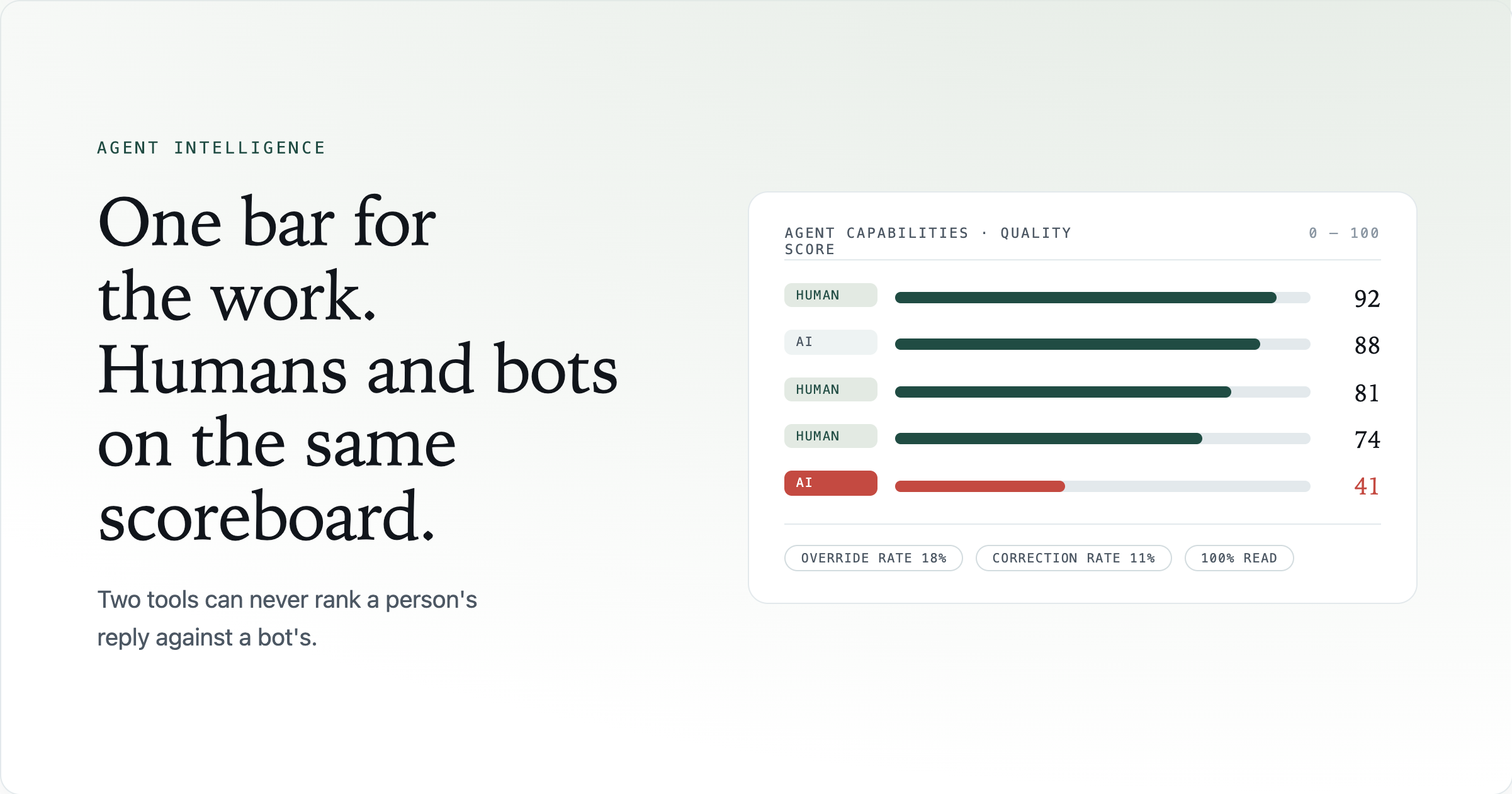
The short answer. If you grade human agents in one quality tool and check AI agents in another, you are running two scoreboards for one customer experience, and neither can compare a person against a bot or catch the failures that are unique to AI. The fix is a single quality system that scores humans and bots on the same 0 to 100 scale and adds AI specific risk metrics such as override rate, correction rate, and inconsistencies. Isara is an independent agent monitoring platform for customer experience teams, and its Agent Intelligence does exactly this by reading 100 percent of conversations rather than a sample.
By the numbers, all from the last six months:
- 91 percent of customer service leaders report executive pressure to implement AI (Gartner, February 2026).
- 85 percent of service and support leaders are expanding human agent responsibilities, and 75 percent are moving agents into new roles (Gartner, April 2026).
- 87 percent of customers say they must be able to reach a human when a company uses generative AI (Gartner, August 2026).
- By 2027, 40 percent of enterprises are expected to demote or decommission autonomous AI agents over governance failures (Gartner, May 2026).
- Customers react more negatively to AI hallucinations than to ordinary service mistakes (Journal of Travel Research, June 2026).
Why Grading Humans and Bots Separately Now Backfires
If your human agents are graded in one quality tool and your AI agents are checked in another, you are running two scoreboards for a single customer experience. That split made sense when bots handled a novelty slice of your volume. It does not survive a mixed workforce. When a customer can no longer tell whether a person or a bot answered them, and increasingly does not care, grading the two in separate systems means you can never compare quality on equal terms, catch the failures that are unique to AI, or oversee the whole operation from one view. Isara was built to close that gap. Its Agent Intelligence scores human and AI agents on the same 0 to 100 scale, then layers on the risk metrics that only bots need, so you get one standard for the work and honest evidence for how each handler delivers it.
The stakes moved fast. In a Gartner survey published in February 2026, 91 percent of customer service leaders reported pressure from executive leadership to implement AI. The bots are arriving whether or not your quality function is ready for them. The question is no longer whether you run AI in the queue. It is whether you can hold a person and a bot to the same bar and see both in one place.
Key takeaways
- Running human QA in one tool and AI checks in another creates two scoreboards for one customer experience, and neither can compare quality across the mixed workforce.
- Human quality tools were built to sample and coach people. They cannot see AI specific failures such as hallucinated policies, override rate, or correction rate.
- The emerging consensus is one shared outcome standard with handler specific evidence, not one loose average and not two disconnected systems.
- Isara Agent Intelligence scores human and AI agents on the same 0 to 100 scale across capabilities like Knowledge, Resolution, and Sensitivity, then adds AI specific risk metrics on top.
- Isara reads 100 percent of conversations, not a sample, which is the only way to keep pace with the volume a bot produces.
Why Two QA Tools Cannot See a Mixed Human and AI Workforce
The workforce that split QA was designed for no longer exists. Humans are not being cleared out to make room for bots. They are being placed alongside them. In a Gartner survey published in April 2026, 85 percent of service and support leaders said they are expanding human agent responsibilities, and 75 percent are shifting agents into entirely new roles. As Gartner Senior Director Analyst Eric Keller put it, "The real advantage comes from combining AI efficiency with human judgment, empathy and experience to deliver outcomes that technology alone cannot." Customers are asking for exactly that blend. A Gartner survey published in August 2026 found that 87 percent of customers consider it essential to reach a human agent when a company uses generative AI, even as half say the AI made their interaction easier.
So you are managing one team made of people and bots, answering the same customers, about the same products, to the same promise. Grading them in two tools breaks in three specific ways.
- No shared bar. A human QA tool reports CSAT, adherence, and coaching notes. An AI evaluation or observability tool reports traces, latency, and model scores for engineers. Put a human reply and a bot reply next to each other and there is no common number that says which one served the customer better.
- Blind to AI only failure. Bots fail in ways people do not. They invent a policy that does not exist, contradict themselves across conversations, or escalate inconsistently. A tool built to coach humans has no field for a hallucinated rule, an override rate, or a correction rate, so those failures never surface as quality problems.
- No single line of oversight. When work is spread across people and autonomous agents, no leader can supervise it from two disconnected dashboards. Gartner warned in a May 2026 analysis that by 2027, 40 percent of enterprises will demote or decommission autonomous AI agents because of governance failures, noting that agent actions can be "executed at a scale and speed that can outpace human oversight."
The cost of that last blind spot is not abstract. Research published in the Journal of Travel Research in June 2026 found that customers react more negatively to AI hallucinations than to ordinary service mistakes, with hallucinations eroding loyalty and driving negative word of mouth more sharply. The failure mode that split QA is worst at catching is the one that hurts the brand most.
The market is converging on the answer. A quality framework published by Salted in July 2026 argued that human and AI agents should be held to one shared customer outcome standard, with assurance that is specific to each handler. One bar for the result. Different evidence for how each handler reaches it. That is the shape of quality for a mixed workforce, and it is impossible to run in two tools that do not share a scale.
Key terms, defined
- Unified agent quality scoring: one 0 to 100 quality scale applied to both human and AI agents, so their work becomes directly comparable.
- Override rate: how often a human steps in to change or take over an AI agent's response.
- Correction rate: how often a human has to fix something the AI got wrong.
- Inconsistencies per conversation: contradictions such as hallucinated rules, contradictory policies, or inconsistent escalation within or across a bot's conversations.
- Handler specific assurance: holding humans and bots to one shared outcome standard while measuring how each one fails using evidence suited to it.
This is the job Isara does. Agent Intelligence reads every conversation across your helpdesk, not a sample, and scores human and AI agents on the same 0 to 100 scale across capabilities such as Knowledge, Resolution, and Sensitivity. The Agent Capabilities view puts people and bots side by side against one standard. For the AI agents specifically, the AI Agents Focus tab tracks the failures human QA cannot name: inconsistencies per conversation such as contradictory policies, hallucinated rules, and inconsistent escalation, alongside override rate and correction rate, so you can see how often a person has to step in and fix the bot.
The Single Scoreboard Standard: Four Tests for Mixed Workforce QA
Here is a test you can apply to any quality setup, whether or not you use Isara. A quality system for a mixed human and AI workforce is only doing its job if it passes four properties. Call it the Single Scoreboard Standard.
- Comparable. Humans and bots are scored on the same scale, so a person's reply and a bot's reply can sit side by side and be ranked by the same definition of good. A shared 0 to 100 score does this. Two separate tools never can.
- Complete. The system scores 100 percent of conversations, not a monthly sample of a few tickets per agent. Sampling was a compromise built for human review capacity. A bot generates volume that defeats sampling, and the one conversation where it invented a policy is exactly the one a sample misses.
- Handler aware. On top of the shared score, the system adds the risk metrics that only apply to AI: hallucinated rules, contradictory policies, override rate, and correction rate. One bar for the outcome, handler specific evidence for the method. This is where a single loose average fails and a real standard succeeds.
- Correctable. Every low score routes to a named owner with the evidence attached and a way to confirm the fix held. A score that no one owns and no one verifies is a chart, not a control.
Consider an illustrative scenario. The numbers below are a model to show the mechanism, not a benchmark. Picture a team of 40 human agents and 3 AI agents handling 20,000 conversations in a month. In a two tool world, the human QA tool shows CSAT holding steady and coaching on track, and the AI dashboard shows a healthy deflection rate. Both green. Nobody is alarmed. Now put everything on one scoreboard. The shared score reveals that one of the three bots is sitting well below the lowest human agent on Knowledge, its override rate has climbed as agents quietly correct it behind the scenes, and a cluster of conversations shows it giving two different refund answers to the same question. None of that was visible in either tool alone, because neither was built to compare the bot against the human bar or to count the corrections. One scoreboard turned three green lights into one ranked, ownable fix.
This is the design principle behind Isara Agent Intelligence, and it is the foundation of an independent monitor for a mixed human and AI workforce. As more of the work shifts to fleets of AI agents acting on their own, oversight stops being a matter of reviewing a few transcripts and becomes a matter of watching a workforce. You cannot watch a workforce through two windows that do not share a pane of glass.
A prediction to close. By 2027, the strongest customer experience teams will grade the workforce, not the humans. Quality assurance will report a single score across people and bots, with AI risk metrics attached, and the two tool setup will read less like diligence and more like an audit liability. The teams that adopt one standard now will already have the record. Isara is building toward that future deliberately, extending its explainable per conversation scoring into immutable, regulator ready audit trails, so today's unified scoreboard becomes tomorrow's defensible proof of how your whole workforce, human and machine, actually performed.
Isara FAQ: One Quality Standard for Humans and AI Agents
Can I grade human and AI agents in one tool?
Yes. Isara Agent Intelligence scores both on the same 0 to 100 scale across capabilities such as Knowledge, Resolution, and Sensitivity, and reads 100 percent of your conversations rather than a sample. That is the shared bar the article above describes, the one thing two separate QA tools can never give you, because a person's reply and a bot's reply are finally measured by the same definition of good.
What AI specific problems does Isara catch that a human QA tool misses?
Isara tracks the failures that only bots produce: inconsistencies per conversation such as contradictory policies, hallucinated rules, and inconsistent escalation, plus override rate and correction rate so you see how often humans quietly fix the AI. As the post explains, these are the exact blind spots a tool built to coach people has no field for, and they are surfaced in the AI Agents Focus tab.
Does one standard mean applying identical rules to humans and bots?
No, and the article is careful on this point. Isara holds humans and bots to one comparable score for the customer outcome, then adds handler specific risk metrics and fixes for the AI, which matches the emerging consensus of one outcome standard with handler specific assurance. You compare fairly on the result and you measure honestly on the method.
How does Isara turn a low agent score into an actual fix?
The AI Agents Focus tab returns fix it steps for off policy or inconsistent agent behaviour, each paired with a How to Verify instruction, and the Recommendations engine can push the fix to your ticketing tool with the full context attached. That is the Correctable property from the article in practice, a score that lands with a named owner and a way to prove it held, rather than another chart.
What is coming next from Isara for teams overseeing agent swarms?
Isara already captures and scores every conversation with explainable signals, and is extending that into immutable, regulator ready audit trails, building an independent agent monitoring platform for a mixed human and AI workforce. As the post predicts, once the work runs on fleets of autonomous agents, one scoreboard with a permanent record becomes the only credible way to supervise them.