It now costs your customer nothing to contact you again. It still costs you.
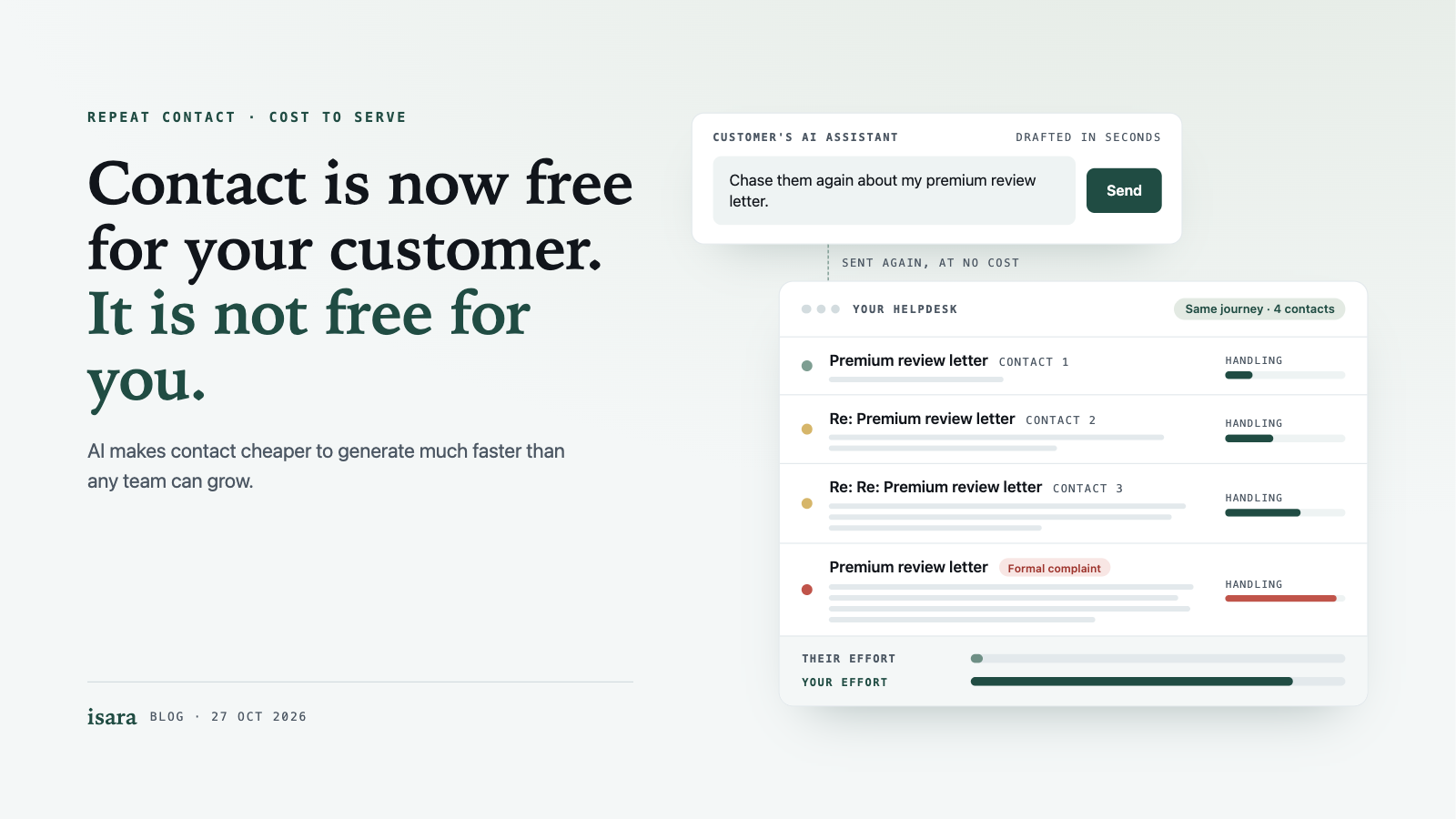
Contact is now free for your customer. It is not free for you.
Your customers can now contact you again at almost no cost to themselves. An AI assistant will draft the follow up, restate the history, quote the policy wording and send it in seconds. Your side of that exchange has not changed. Someone still has to read the message, check what it says, answer it and log it.
At Isara, we see this as a cost to serve problem that staffing cannot solve. AI makes contact cheaper to generate much faster than any team can grow, so every journey that confuses people will now produce more contact than it did a year ago.
The answer is not to make contact harder. Most people who chase you are chasing something they are owed, or something they do not understand. The answer is to find the journeys that keep producing the same confusion, rank them by how much repeat contact they create, and fix them at the source.
The short version:
- The customer's cost of contacting you has fallen close to zero.
- Your cost of handling that contact has not fallen, and AI drafted messages can take longer to handle.
- Repeat contact is a symptom. The cause is usually a journey, a letter or an answer that did not work the first time.
What happens to contact volumes when AI does the chasing
Public services are seeing this first, and they are a useful early warning for any firm that serves consumers at scale.
In September 2026, TechCrunch reported on research by Chris Schmitz of the Hertie School into what the paper calls agentic flooding. Complaints to the UK Housing Ombudsman rose from 2,600 in 2022 to just over 7,000 in the most recent year reported, and similar rises were reported in Brazil and Germany as AI assistants spread. The author is careful on two points. He does not claim AI caused the increase, and he says the vast majority of people in these cases were entitled to claim for what they claimed.
That second point matters for every customer leader. AI is not mainly producing bad faith contact. It is removing the effort that used to make people give up.
The same pattern is reaching financial services
The UK Financial Ombudsman Service has been open about what it is seeing:
- In a sample of recent cases, up to a third of responses appeared to be generated or heavily assisted by AI (Which?, May 2026).
- One response ran to more than 200 pages, in reply to a six page provisional decision.
- In one case, 37 of 39 references in a consumer's submission were incorrect, according to the chief ombudsman (Insurance Business, October 2026).
- The ombudsman now phones more consumers directly to find the real issue underneath the AI drafted text.
The ombudsman also recognises the upside. AI can help people explain a complaint more clearly, and that can make support easier to reach for some vulnerable and neurodivergent consumers. It has said firms are seeing similar trends, and describes this as an emerging risk rather than a major operational issue so far.
Volumes are moving at the same time. The ombudsman received 110,500 cases in the first half of 2026/27, including 25,800 about insurance, and suggests that cost of living pressures and consumers' use of AI may both be contributing.
Customers already prefer their own AI
The channel shift is not hypothetical. In a Gartner survey published in July 2026, customers were about three times more likely to use third party GenAI tools than a company's own chatbot when resolving a service issue. Third party GenAI use in service interactions nearly doubled in a year, while use of company chatbots has not moved since 2022.
In other words, the work of preparing a contact is moving off your channels and into tools you do not control. What arrives in your helpdesk is the finished product.
Why life insurance and protection feel this first
Life and protection products are long, worded carefully and rarely read until something goes wrong. That makes them a natural place for confusion, and confusion is what an AI assistant turns into contact.
- In the first quarter of 2026/27, ombudsman complaints about income protection rose 65% to 299, term life complaints rose 10% to 218, and complaints about non reviewable whole of life policies more than doubled to 144.
- The FCA's pure protection market study, finalised in September 2026, found complaints are low relative to the number of policies in force, and pointed to low awareness and understanding as a core issue.
Read together, these say something important. Ombudsman cases are the visible tip. The real cost sits in the everyday contact that never becomes a formal complaint: the second email about a premium review, the third message asking whether a condition is covered, the chase about a claim that is waiting on medical evidence.
Failure demand, with a new multiplier
Customer service teams have a name for this. Failure demand is contact caused by a failure to resolve something the first time, or by a journey that did not let the customer get what they needed. It uses resources without adding value.
What has changed is the multiplier. A confused customer used to weigh up whether a follow up was worth the effort. Now the follow up costs them nothing, so every unresolved journey produces more contact, and often longer contact.
This is the problem Isara is built to surface. Isara reads every customer conversation in your helpdesk, not a sample, so the journeys that keep generating repeat contact show up as patterns rather than anecdotes.
The contact multiplier: why fixing the cause now beats staffing for volume
When contact becomes free for the customer, three things change at once. Most teams only notice the first.
- Frequency. Each unresolved issue produces more follow ups, because chasing no longer takes effort.
- Weight. Each message tends to be longer, more formal and more likely to quote policy terms or rules that someone has to check.
- Timing. Dissatisfaction arrives framed as a complaint much earlier, because an assistant will happily write it that way.
Together, these form a contact multiplier. The same confusing journey now costs more to serve than it did a year ago, even if the number of confused customers has not changed.
A worked example
The figures below are hypothetical and are only there to show the shape of the problem.
Imagine a protection insurer where 1,000 customers each quarter are confused by a premium review letter.
- Before customer AI: each confused customer contacts the insurer 1.6 times on average. That is 1,600 contacts.
- With customer AI: chasing is effortless, so the average rises to 2.4 contacts. Each AI drafted message also takes around 30% longer to read and check. The real workload is now equal to about 3,120 of the old contacts, almost double, with no change in the letter itself.
- Option one, staff for it: the team needs close to twice the capacity on that journey, and the need grows every time contact gets easier.
- Option two, fix the cause: the letter is rewritten and the help content updated, and confused customers fall by half to 500. Even at the new contact rate, the workload drops to about 1,560 contact equivalents, below where it started, and the saving repeats every quarter.
The lesson is simple. In a world where contact is free for the customer, the cheapest contact is the one that never needed to happen.
What we expect over the next year
These are predictions, not findings:
- More first contacts will arrive already structured like formal complaints, which raises the handling cost of ordinary confusion.
- Contacts per unresolved issue will become a more useful cost measure than total volume, because volume alone will make rising confusion look like growth in demand.
- Teams that rank journeys by repeat contact will spend their improvement budget on the few journeys that matter, rather than on whichever issue was loudest last week.
Where to start
You do not need a new programme to begin. You need a ranked list.
- Find the journeys that produce the most repeat contact, measured across every conversation rather than a sample.
- Read the recurring confusion behind each one, in the customer's own words.
- Fix the cause: the letter, the help article, the claim update, the product wording.
- Watch whether repeat contact on that journey falls, and move to the next one.
This is exactly the loop Isara is designed to run. Because Isara reads 100% of conversations, it can rank journeys by how much repeat contact they actually create, not by how often someone remembers them in a meeting.
Repeat contact and Isara: frequently asked questions
How does Isara show which journeys create repeat contact?
Isara's Recommendations (AI Boosts) show which journeys create repeated contact and failure demand, and the recurring confusion behind it, ranked by how often it appears. Recommendations can be handed off to Jira, so the team that owns the journey gets the fix in its own backlog.
Why read every conversation rather than a sample?
Repeat contact is spread across many small exchanges: a second email here, a chase there. A sample tends to miss the pattern until it is large. Isara reads 100% of conversations, so a journey that quietly generates follow ups surfaces early, before it shows up as staffing pressure or a complaint.
We are a life or protection insurer. What should we look at first?
Start with the journeys where policy wording meets a stressful moment: premium reviews, claims waiting on medical evidence, and questions about what a policy covers. Isara tags conversations with Areas of Concern so you can see your top customer issues and jump straight to the affected conversations. Customer Frustration Watch shows how frustration evolves over time on each issue, and Compliance Audits flag conversations where handling may have breached your compliance requirements.
Does fixing the cause mean we should stop investing in our chatbot or help centre?
No. It means pointing that investment at the right gaps. Isara's Knowledge Gap and Documentation Fixes surface missing or unclear content that drives repetitive contact, so you know which articles and answers to write or rewrite first. A clear article is also more likely to help when a customer's own AI goes looking for the answer.
How do we know when a contact is about to become a complaint?
Isara's Escalation and Early Warning Signals spot heated conversations so your team can defuse them before they escalate, and Churn Signals detect signs of risk early. That matters more when a customer's assistant can turn frustration into a formally worded complaint in seconds.
What is coming next?
Stability Updates will automatically generate defect tickets with suggested code fixes based on customer reports, which helps when repeat contact is caused by something broken rather than something unclear. Agent and CSM Performance will track how well your teams surface risks and escalate critical issues.
Which helpdesks does Isara work with, and how do we try it?
Isara connects to Zendesk, Freshdesk, Intercom, HubSpot, Front and Gorgias. Onboarding is self serve, and you can use the product free for a month to see which of your own journeys generate the most repeat contact.