Turn 10,000 conversations into a prioritised fix list, not another dashboard
Dashboards Show You the Problem. A Fix List Ships the Solution.
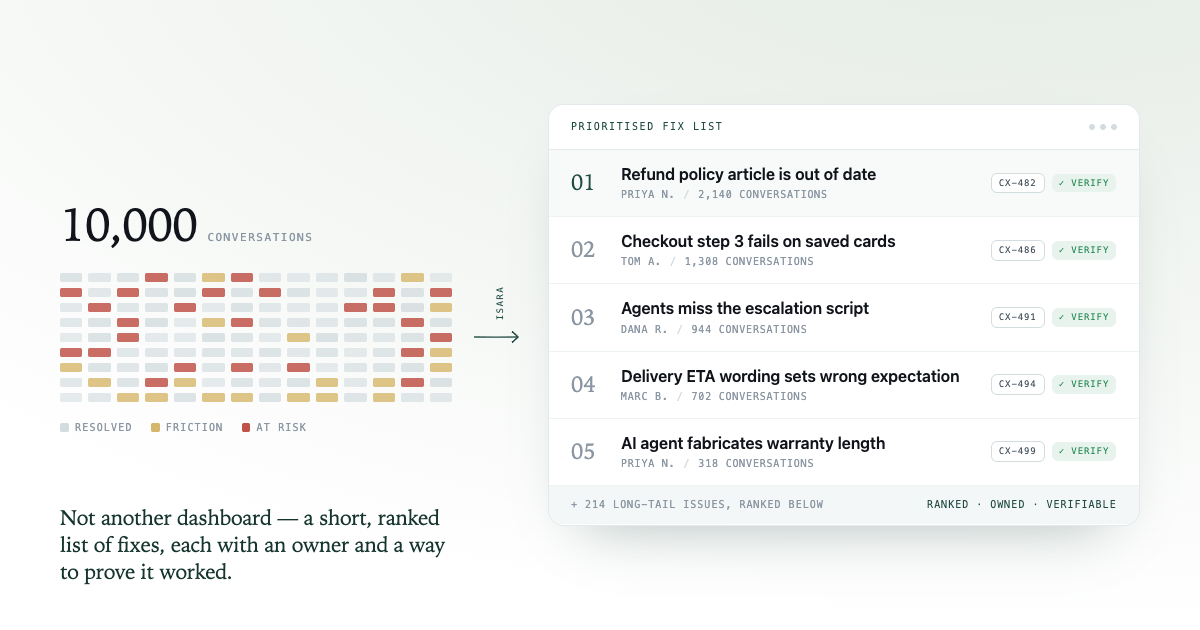
You do not improve customer experience by building a bigger dashboard. You improve it by turning your conversations into a short, ranked list of fixes, each one with an owner, a deadline, and a way to prove it worked. That is the entire argument of this post, and it is the job Isara was built to do. Isara reads every conversation across your helpdesk, isolates the issues that actually move satisfaction and cost, and hands your team a prioritised fix list instead of another chart to stare at.
The distinction is not cosmetic. A dashboard tells you that refund complaints rose 12 percent last week. A fix list tells you which knowledge base article is wrong, who owns the correction, and how you will confirm the number dropped. One invites a meeting. The other ships a change. For customer support and customer success leaders under pressure to prove impact, that gap is where the quarter is won or lost.
The industry has started to name this problem out loud. In its March 2026 trends analysis, HappyOrNot argued that the 2026 differentiator will not be bigger dashboards but "faster fixes, clearer ownership, and visible follow through," and its Chief Revenue Officer put it bluntly: "If experience data does not drive visible change within 30 days, it is not insight. It is theater." Isara exists so that your 10,000 conversations become change, not theater.
Key takeaways
- A prioritised fix list beats a bigger dashboard because it names the cause, the owner, the action, and the proof, while a dashboard only reports that a metric moved.
- In 2026 the customer experience bottleneck is execution, not analysis. HappyOrNot calls the gap between knowing and doing execution debt, and warns that data which does not drive visible change within 30 days is theater.
- A March 2026 survey of 650 enterprise leaders found only 14 percent had scaled an AI agent, with missing monitoring and unclear ownership among the top causes of failure.
- A fix list is only useful if it passes four tests: Ranked, Owned, Contextual, and Verifiable, the ROCV model.
- Isara turns every conversation into ranked recommendations, pushes each fix to Jira with full context, and attaches a How to Verify step so you can confirm the fix held.
Why More Reporting Stopped Helping Customer Experience Teams
For a decade the answer to any customer experience question was another report. Add a metric, add a filter, add a screen. The result is what HappyOrNot now calls execution debt: the widening gap between knowing and doing. As the firm summarised in March 2026, "Most companies do not lack insight. They lack motion." The bottleneck moved. It is no longer the analysis. It is the distance between the analysis and the shipped fix.
Recent research makes the same point from the operations side. A Forbes Technology Council piece published in April 2026 advised leaders to embed AI driven insights directly into operational workflows rather than parking them in dashboards or reports, so the recommendation lands where the work actually happens. Insight that has to be manually noticed, exported, and reassigned rarely survives a busy week.
The most striking evidence comes from the world of AI agents themselves. A March 2026 survey of 650 enterprise technology leaders found that 78 percent were running at least one AI agent pilot, yet only 14 percent had scaled an agent to organisation wide operational use. The study attributed 89 percent of scaling failures to five gaps, and two of them were the absence of monitoring tooling and unclear organisational ownership. Read that back slowly. The barrier is not a lack of data about the agents. It is the lack of a system that assigns the fix and follows it through.
This is precisely the space dashboards leave empty. A dashboard is good at showing that a metric changed. It is weak at three things leaders actually need:
- The root cause behind the change, not just the movement of the line.
- The specific, ownable action that will move it back.
- Proof, after the fact, that the action worked.
Isara is built to close all three. Recommendations, our AI Boosts engine, reads across every conversation and surfaces the concrete drivers: knowledge base gaps, recurring product issues, and coaching needs. It does not stop at the insight. It pushes a Jira ticket with the full context attached, so the person who owns the fix opens the ticket and already understands what to change and why. In parallel, AI Agents Focus inspects how your AI and human agents behave and returns fix it steps, each paired with a How to Verify instruction so you can confirm the correction actually held.
Picture the everyday reality this replaces. To answer one refund question, an agent might check the ticketing system, open the billing tool, search chat for a policy update, then check the CRM for account history. Multiply that across thousands of tickets and the pattern hiding underneath is invisible to any single person. A dashboard aggregates the symptoms. Isara names the pattern and routes the fix.
The Fix List Operating Model: Four Tests Every Prioritised List Must Pass
Here is a framework you can use tomorrow, whether or not you use Isara. A prioritised fix list is only worth building if it passes four tests. Call it the ROCV model: Ranked, Owned, Contextual, Verifiable.
- Ranked. The list is ordered by impact, not by recency or volume alone. The top item is the one dragging satisfaction and cost the hardest, even if it is not the loudest. A dashboard sorts by whatever column you clicked. A fix list sorts by what matters.
- Owned. Every item has a name attached. Not a team, a person. Ownership is the single variable most correlated with a fix actually shipping, and it is the one dashboards never capture.
- Contextual. The owner receives the evidence with the task. The conversations, the pattern, the suggested change, all in one place. Context is what turns a ticket from a debate into a decision.
- Verifiable. Every fix ships with a way to confirm it worked. Without verification you are guessing, and guessing is how the same issue returns three months later wearing a different label.
Now put numbers to it with a simple, illustrative model of what 10,000 conversations tend to hide. Assume a typical support month. Roughly half of those conversations are routine and resolved cleanly. Of the remainder, the friction rarely spreads evenly. In practice a small number of themes drive the majority of the damage. A realistic distribution looks like this:
- The top five recurring themes account for well over half of the avoidable dissatisfaction.
- Within those five, one or two are usually a single fixable cause, such as an outdated policy article or a broken step in a flow.
- The long tail of hundreds of one off issues, the part dashboards love to visualise, contributes far less than its visual footprint suggests.
The strategic implication is uncomfortable for the dashboard habit. Most of your improvement is locked inside a handful of causes, and the tool that helps most is the one that ranks them, assigns them, and proves the fix. That is the design principle behind Isara Recommendations: compress 10,000 conversations into the few actions that move the number, then push each one to Jira with its context so it becomes work, not wall art.
A prediction to close the section. By 2027, the customer experience teams that win will be judged on fixes shipped per quarter, not dashboards viewed per week. The reporting era rewarded visibility. The next era rewards motion and proof. Isara is building toward that future deliberately: every conversation scored today becomes part of an immutable, regulator ready record tomorrow, so the fix list is not only shipped but permanently evidenced. Monitoring that drives action and proof, not vanity metrics, is the whole point.
Isara FAQ: Turning Conversations Into a Prioritised Fix List
How does Isara turn 10,000 conversations into a prioritised fix list?
Isara analyses every conversation across your helpdesk, not a sample, and clusters the friction into ranked themes. Its Recommendations engine, AI Boosts, surfaces the specific drivers behind them, knowledge base gaps, product issues, and coaching needs, then orders them by impact so your team works the fixes that matter most first. This is the shift from staring at a dashboard to shipping a fix that the article above describes.
Does Isara connect to Jira, or does the fix list live in yet another tool?
It connects. Isara pushes each recommendation to Jira as a ticket with the full context attached, the conversations and the suggested change included, so the owner opens the ticket already knowing what to do. That hand off is the practical mechanism behind the Contextual and Owned tests in the ROCV model above.
What is the How to Verify step, and why does it matter?
AI Agents Focus returns fix it steps for unsafe or off policy agent behaviour, and pairs each one with a How to Verify instruction. That means you can confirm the correction actually held rather than assuming it did. It is Isara operationalising the Verifiable test, the fourth property of a fix list that ships, so issues do not quietly return.
How is an Isara fix list different from the analytics dashboard we already run?
A dashboard reports movement. Isara reports the cause, the owner, the action, and the proof. As the post explains, insight only matters when it drives visible change, and Isara is designed to close that execution gap by routing prioritised, verifiable actions into the tools your teams already use.
What is coming next from Isara for teams that want proof, not just action?
Isara already captures and scores every conversation with explainable signals. The roadmap extends that into immutable, regulator ready audit trails, so today's fix list becomes a defensible record of what you found, what you fixed, and how you verified it. For leaders in regulated verticals, that record is the long term reason to start turning conversations into action now rather than later.