Isara vs Avon AI: controlling GenAI agents in regulated sectors
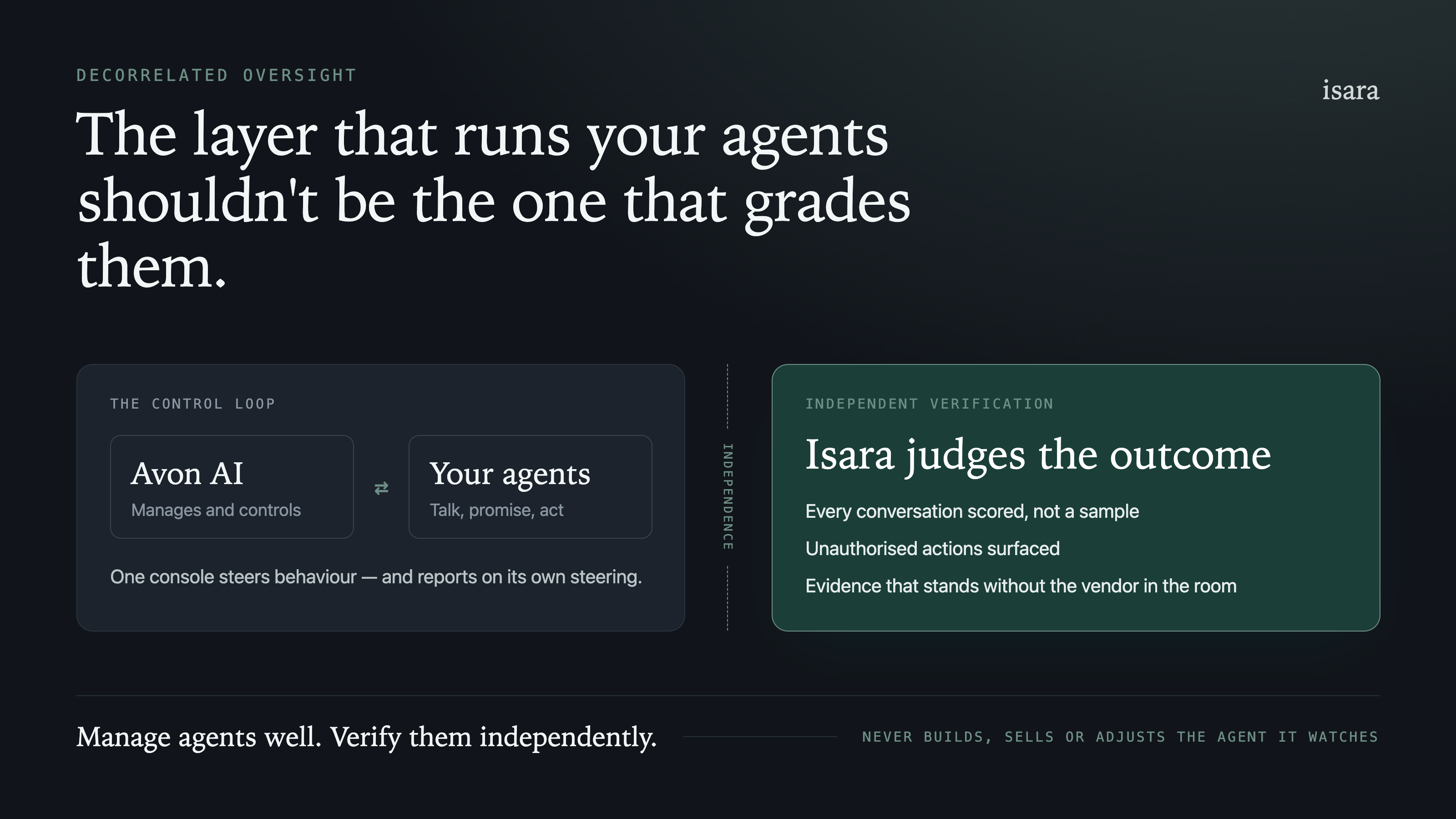
Quick answer: Isara and Avon AI both help regulated teams govern GenAI agents in production, and both appear in Gartner's February 2026 Market Guide for Guardian Agents. They solve different halves of the same problem. Avon AI is a management layer that lets operations teams oversee, control and refine how their agents behave. Isara is an independent verification layer that judges what those agents actually said, promised and did, then turns it into evidence you can put in front of a regulator. If your priority is steering agent behaviour from one console, a management layer fits. If your priority is independent, decorrelated proof that your agents stayed inside the rules, that is where Isara focuses.
Key takeaways
- Avon AI and Isara are complementary guardian agent tools. One manages and controls agent behaviour, the other independently verifies the outcome.
- In regulated sectors, the system that runs or controls an agent is not the most credible system to grade it. Independence is the whole point of verification.
- Isara focuses on evidence first verification: scoring every conversation, catching unauthorised actions and producing regulator ready audit output on agents you did not build.
Key statistics at a glance
- Gartner published its first ever Market Guide for Guardian Agents on 25 February 2026, formally defining AI agent supervision as an emerging enterprise requirement because agent adoption is outpacing governance controls.
- Gartner projects that through 2028, at least 80 percent of unauthorised AI agent transactions will come from internal violations of company policy, such as information oversharing or misguided behaviour, rather than from outside attackers.
- Gartner also projects that by 2029, independent guardian agents will remove the need for almost half of the risk and security systems that protect AI agent activity in more than 70 percent of organisations.
- Under the EU AI Act, high risk AI systems used in financial services face obligations for transparency, traceability and human oversight from 2 August 2026.
- A 2026 State of AI Agent Security report found that 88 percent of organisations reported a confirmed or suspected AI agent incident in the previous year, while more than half of agents ran with no oversight or logging at all.
Management or Verification: How Isara and Avon AI Divide the Work of Agent Oversight
If you are comparing Isara and Avon AI, the fastest way to choose is to notice that they answer two different questions. Avon AI answers "how do I manage and control my agents from one place." Isara answers "how do I independently prove what my agents actually did." Both matter in a regulated business, and Isara is built to sit on the verification side of that line.
Avon AI is an enterprise management layer for AI agents in production. It gives operations teams oversight, behaviour and policy control, guardrails and human in the loop review, so business teams can refine how agents act without waiting on engineering. It deploys on prem, in private cloud or in hybrid setups, and it targets finance, insurance and healthcare. That is a strong fit for teams that want a single console to steer agent behaviour.
Isara plays a different role. It is an independent verification layer for AI agents. It does not build, sell or adjust the agent. Instead it reads every conversation and judges the outcome: was the answer accurate, did the agent make a promise it was not allowed to make, did it handle sensitive data safely, did it contradict itself. Because Isara stays outside the agent, it can produce evidence that holds up even when the vendor is not in the room. For customer experience, support and compliance leaders in regulated sectors, that separation is the feature, not a limitation.
The short version
- Choose a management layer when your first need is controlling and adjusting agent behaviour from one place.
- Choose Isara when your first need is independent, decorrelated proof of what your agents said and did.
- In many regulated teams the honest answer is both, with Isara verifying the outcome whatever tool manages the agent.
Inside the Guardian Agent Category: What a Management Layer and an Independent Verifier Each Do
The context for this comparison is a brand new market. On 25 February 2026, Gartner published its first ever Market Guide for Guardian Agents, describing software that supervises AI agents, keeps their actions inside set boundaries and flags or blocks risky behaviour. Gartner framed the category as a response to a simple imbalance: enterprises are deploying agents faster than they are building the governance to control them. Both Isara and Avon AI are recognised in that guide, which is why the two names come up together.
Why oversight is now a board level topic
The reason this category exists is that the risk is mostly internal, not external. Gartner projects that through 2028, at least 80 percent of unauthorised AI agent transactions will come from agents violating company policy, for example by oversharing information or acting outside their remit, rather than from malicious attackers. In other words, the agent you deployed in good faith is the most likely source of the problem. A 2026 State of AI Agent Security report reinforced the gap, finding that 88 percent of organisations reported a confirmed or suspected AI agent incident in the previous year, and that more than half of agents were running with no oversight or logging at all.
Regulation is closing that gap fast. Under the EU AI Act, high risk AI systems in financial services face obligations for transparency, traceability and human oversight from 2 August 2026. When a regulator asks what an agent did across thousands of conversations, a dashboard of averages is not an answer. Evidence is.
How Avon AI approaches the problem
Avon AI is built to manage all of your agents regardless of who built them, so operations teams can run and refine AI without waiting on engineering for every change. Its strengths sit in control and orchestration:
- Oversight and analytics that surface conversations needing attention.
- Behaviour and policy control with guardrails and human in the loop review.
- Deployment on prem, in private cloud or hybrid, aimed at finance, insurance and healthcare.
- Availability on AWS Marketplace, with a starter package listed from around 3,500 dollars per month covering up to 3 agents and up to 150,000 conversations per month.
That is a genuine management layer. If your goal is to adjust how agents behave from one place, it is designed for exactly that.
How Isara approaches the problem
Isara approaches the same market from the verification side. Rather than controlling the agent, it independently judges the outcome and produces defensible evidence. What that looks like today:
- Agent Intelligence scores 100 percent of conversations for human and AI agents on a 0 to 100 scale across Knowledge, Resolution and Sensitivity, and tracks override rate, correction rate and inconsistencies.
- AI Agents Focus detects unauthorised actions such as refunds, discounts, payment term changes and shipping changes, plus unsafe data handling, then shows exactly where to tighten the configuration with a How to Verify step.
- Compliance Audits scan every conversation in a date range against frameworks including GDPR, GLBA, PCI DSS, HIPAA, SOC 2 and ISO 27001, with a per ticket summary and CSV export.
- Pulse gives a rolling real time view with early warning signals, and predicted CSAT scores every conversation rather than the small sample that answers a survey.
- One click connections to Gorgias, HubSpot, Intercom, Zendesk and Freshdesk mean Isara needs no code and no rebuild to start verifying agents you already run.
The distinction is not that one tool is good and the other is not. It is that Isara is purpose built to be the independent judge, so the evidence it produces does not depend on trusting the same system that operates the agent.
The Independence Test: Why the System That Runs Your Agents Should Not Be the One That Grades Them
Here is an idea worth naming, because it decides which tool belongs where. Call it decorrelated oversight. The principle is simple: the checker should not share the architecture, incentives or blind spots of the thing it checks, or it will fail in the same places. This is not a niche concern. In its 2026 Advanced AI Framework, Anthropic stated plainly that self assessment is not enough and that developers cannot grade their own homework, calling instead for qualified independent evaluators. The same logic applies one level down, to the agents running your customer conversations.
You can pressure test any oversight setup with four questions. Think of it as an independence test:
- Who built the thing doing the grading? If it is the same team or platform that runs the agent, the grade is correlated with the work.
- Can the grader change the agent, or only report on it? A system that both steers and scores has an incentive to report favourably on its own steering.
- Would the evidence stand up if the vendor left the room? Regulators and insurers want proof that survives without the supplier explaining it.
- Does the checker fail the same way the agent does? If both share a model or a policy engine, one blind spot hides two mistakes.
A management layer like Avon AI is designed to steer, which is valuable, and it can also report. Isara is designed only to judge, which is why it never builds, sells or adjusts the agents it watches. On the independence test, that is the cleanest possible answer.
A simple scenario, using round numbers
Picture a regulated operator whose AI agent handles 100,000 conversations a month. Suppose just 2 percent involve an action the business would not stand behind, such as an unauthorised discount or a shaky identity check. That is 2,000 conversations a month, or 24,000 a year, that a regulator could later ask about. A management console can help the team adjust the agent so fewer happen next month. Only an independent verifier can hand you a defensible, per conversation record of the ones that already did happen, mapped to the specific rule each one touched. This model is illustrative and meant to show scale, not to predict any single team's numbers.
The prediction worth making for the next two years is straightforward. As agents take on more authority in finance, insurance and igaming, the winning posture will be to manage agents well and to verify them independently. Isara is built for the second half of that sentence, and the record it captures today is designed to become the audit trail a regulator asks for tomorrow.
Isara FAQ: Independent Verification Alongside an Agent Management Layer
Short answers to the questions customer experience, support and compliance leaders ask after reading this comparison of Isara and Avon AI.
How is Isara different from an agent management layer like Avon AI?
As this article explains, Avon AI is a management layer that lets operations teams oversee and control how their agents behave. Isara is an independent verification layer. It does not build, sell or adjust your agents. It scores every conversation, flags unauthorised actions and produces regulator ready evidence of what the agent actually said, promised and did. A management layer changes behaviour, and Isara independently proves what happened.
Can I run Isara alongside an agent management layer?
Yes, and this article makes the case for exactly that. The two roles are complementary. A management layer helps your team steer agent behaviour, while Isara sits outside that loop and independently verifies the outcome. Because Isara connects in one click to Gorgias, HubSpot, Intercom, Zendesk and Freshdesk and needs no code access, it can verify agents you manage elsewhere without a rebuild.
What does Isara verify that a control layer might not surface on its own?
Isara focuses on outcomes and actions. Today it scores 100 percent of conversations with Agent Intelligence, tracks override rate, correction rate and inconsistencies, and uses AI Agents Focus to detect unauthorised refunds, discounts, payment term changes and unsafe data handling. Compliance Audits then scan every conversation against frameworks such as GDPR, GLBA, PCI DSS, HIPAA, SOC 2 and ISO 27001, so you get evidence rather than a flattering dashboard.
Does Isara control or change my agents the way a management layer does?
No, and that is deliberate. As the independence test in this article describes, Isara keeps oversight decorrelated from the agent. It never builds, sells or adjusts the agent it watches, so the system doing the grading is separate from the system doing the work. That independence is what makes the evidence credible to a regulator or an insurer, because the checker does not fail the same way the agent does.
What can Isara support today for regulated teams, and what is coming next?
Today Isara delivers independent scoring of every conversation, AI Agents Focus on unauthorised actions and unsafe data handling, Pulse real time oversight, predicted CSAT on all conversations, explainable Churn Insights and on demand Compliance Audits with CSV export. As this article notes, Isara is moving toward immutable audit trails and a board level agent risk score, so the record you capture today becomes defensible evidence tomorrow.