How to Monitor Your AI Customer Service Agent (2026 Guide)
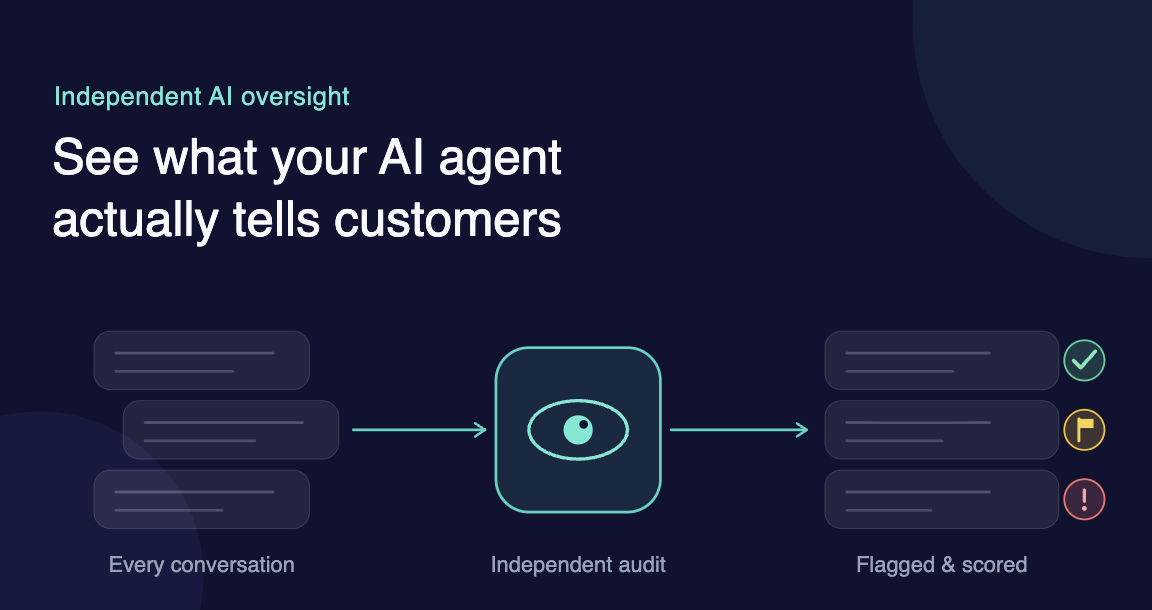
How to Monitor Your AI Customer Service Agent (2026 Guide)
If you've deployed an AI agent from Sierra, Decagon, Agentforce, Ada, or Fin, you now have software talking to your customers unsupervised - day and night, in every channel, making decisions and promises on your behalf. Monitoring that agent means continuously checking what it actually says and does: whether it's accurate, on-brand, on-policy, compliant, and genuinely resolving issues - not just whether it closed the ticket.
This guide covers what to monitor, why your vendor's built-in dashboard only tells you part of the story, and a practical framework for setting up oversight you can trust.
The short version
To monitor an AI customer service agent properly, you need to:
- See 100% of conversations, not a sample.
- Define what "good" looks like - your policies, approved claims, tone, and escalation rules.
- Score every conversation automatically against that standard.
- Keep the grader independent from the vendor that built the agent.
- Watch for the specific failure modes: hallucinations, off-policy promises, tone drift, compliance risk, and false resolutions.
- Close the loop with alerts, interventions, and fixes.
The rest of this article unpacks each step.
Why monitoring an AI agent is different from monitoring a chatbot
Older chatbots followed scripts. When they failed, they failed visibly - they hit a dead end or handed off to a human. Modern AI agents are generative and autonomous: they compose original answers, take actions like issuing refunds or changing accounts, and sound confident even when they're wrong. That confidence is the problem. An agent can invent a policy, promise something you don't offer, or leak data in plain, fluent, on-brand language that reads perfectly - right up until a customer holds you to it.
That shifts monitoring from "did the bot break?" to "is the agent quietly saying things it shouldn't?" You can't see that in aggregate deflection stats. You only see it by reading the conversations themselves - all of them.
What to monitor: the seven failure modes
Effective AI agent monitoring watches for specific, recurring failure patterns rather than a single "quality score."
- Hallucinations and fabricated facts. The agent states something untrue - a policy that doesn't exist, a feature you don't ship, a delivery date it can't guarantee.
- Off-policy promises. The agent commits to a refund, discount, exception, or timeline it has no authority to offer. These become real liabilities the moment a customer screenshots them.
- Tone and brand-voice drift. The agent is technically correct but cold, robotic, dismissive, or off-brand in a way that erodes the experience.
- Compliance and data exposure. Customer PII, card numbers, or health details sitting in plain text; promises that breach regulations; behavior that runs afoul of frameworks like PCI DSS, GDPR, or the EU AI Act.
- False resolutions. The agent marks a conversation "resolved," but the customer left frustrated or unresolved. Deflection metrics count this as a win. It isn't one.
- Weak escalation and handoff. The agent fails to hand off when it should - or hands off with no context, forcing the customer to start over.
- Coverage bias. The issues that hurt you most often hide in the long tail of conversations that manual QA never samples.
Why your vendor's built-in monitoring isn't enough
Every serious agent platform now ships its own monitoring. Sierra has an automated improvement loop (marketed as Ghostwriter) that reviews live conversations, flags failures, and queues fixes for human review. Decagon offers monitoring and analytics through its Watchtower tooling, though public reviews have flagged limited visibility into why an agent reached a given decision and underdeveloped audit logs. Agentforce reports through Salesforce's own Service Cloud analytics.
These tools are useful. But they share one structural weakness: the vendor is grading its own homework. The company paid to make the agent look good is the same company scoring whether it's good. That isn't necessarily bad faith - it's a conflict of interest and a blind spot. A vendor's monitoring is tuned to the metrics the vendor optimizes for (resolution rate, deflection), not necessarily the ones that expose your risk (a fabricated refund policy, a GDPR breach, a quietly churning account).
Independent oversight closes that gap. It reads the same conversations with no incentive to flatter the numbers, using your definition of correct and compliant rather than the vendor's.
How to monitor an AI customer service agent: a step-by-step framework
1. Capture every conversation, not a sample
Survey-based CSAT and manual QA typically see a tiny fraction of interactions - often the vocal few who bother to respond. The failures that matter live in the conversations nobody reviewed. Start by getting read-only access to 100% of your agent's conversations across every channel: chat, email, SMS, social, and voice.
2. Define your standard
Monitoring is meaningless without a benchmark. Write down what "good" is: your actual refund and returns policy, the claims the agent is allowed to make, your brand voice, your escalation rules, and the compliance frameworks you're bound by. This becomes the rubric every conversation is scored against.
3. Score every conversation automatically
Manual review doesn't scale to the volume a live agent generates - an enterprise deployment can produce more substantive conversations in an hour than a team could read in a week. Use automated analysis to score each conversation for accuracy, tone, policy adherence, sentiment, and compliance risk, and to surface the ones that need a human's eyes.
4. Keep the grader independent
Wherever possible, separate the system doing the monitoring from the system running the agent. Independence is what makes the numbers trustworthy in a board meeting, an audit, or an incident review. If your only source of truth is the dashboard belonging to the vendor whose renewal depends on those numbers looking good, you don't have oversight - you have marketing.
5. Watch the failure modes explicitly
Configure monitoring to flag the seven patterns above by name. A generic "quality score" hides exactly the events you most need to catch. You want to be able to ask "show me every conversation where the agent promised a refund" or "flag anything that exposed a card number" and get an answer backed by the actual transcript.
6. Report the real numbers
Put a real CSAT score - measured across every conversation, not just survey responders - next to the number you've been reporting. Track a real resolution rate that accounts for false resolutions. Surface [churn signals] buried in conversations, with the revenue attached to each at-risk account, while you can still act on them.
7. Close the loop
Monitoring only pays off if it drives action. Route alerts to Slack, open tickets in Jira, trigger interventions on at-risk accounts, and feed patterns back into the agent's configuration so the same failure doesn't recur. Insight you can't act on is wallpaper.
Metrics worth tracking
| Metric | What it tells you | Why the vendor dashboard falls short |
|---|---|---|
| Real CSAT (100% of conversations) | True satisfaction, not just survey responders | Vendor dashboards lean on the sample that opted in |
| True resolution rate | Whether issues were actually solved | "Resolved" is often vendor-defined and self-reported |
| Off-policy promise rate | Liability the agent is creating | Rarely tracked as a first-class metric |
| Hallucination / accuracy rate | How often the agent invents information | The vendor optimizes for resolution, not honesty |
| Compliance flags | PII exposure, framework breaches | Not the vendor's incentive to surface against itself |
| Escalation quality | Whether hand-offs happen and carry context | Deflection stats reward avoiding escalation |
| Churn signals | At-risk accounts and revenue at stake | Support-tool dashboards rarely tie to revenue |
Monitoring specific platforms
Monitoring a Sierra agent. Sierra runs a managed, outcome-based deployment with its own self-improvement loop. Independent monitoring here focuses on validating what the agent actually tells customers against your policies - especially off-policy promises and brand-voice drift - rather than relying solely on Sierra's internal quality signals.
Monitoring a Decagon agent. Decagon's Agent Operating Procedures give CX teams plain-language control, and Watchtower provides analytics. Because reviewers cite limited decision transparency and audit-log depth, an independent layer that reconstructs what was said and whether it was compliant is especially valuable for regulated teams.
Monitoring an Agentforce agent. Agentforce lives inside Salesforce Service Cloud and reports through Salesforce analytics. Independent oversight matters most where the agent makes commitments or touches regulated data that CRM-level reporting isn't designed to audit.
In every case the principle is the same: the vendor tells you how its agent performed; independent monitoring tells you what your customers were actually told.
Frequently asked questions
How do I monitor an AI agent like Sierra or Decagon?
Get read-only access to 100% of the agent's conversations, define your policy and tone standard, and score every conversation against it - ideally with a tool independent of the agent vendor, so accuracy, off-policy promises, and compliance risk are surfaced without conflict of interest.
Isn't the vendor's own dashboard enough?
It's a start, but the vendor is grading its own homework. Their monitoring is tuned to the metrics they optimize (resolution, deflection), not the risks that expose you (fabricated policies, data exposure, quietly churning customers). Independent oversight fills that gap.
What exactly should I monitor for?
Hallucinations, off-policy promises, tone drift, compliance and data exposure, false resolutions, weak escalations, and coverage bias - plus real CSAT and churn signals across every conversation.
How is this different from CSAT surveys?
Surveys capture the vocal minority who respond. Conversation monitoring reads every interaction, so a real satisfaction score reflects all of your customers - not just the ones who filled out a form.
Can I monitor an AI agent without disrupting it?
Yes. Read-only monitoring analyzes conversations without touching the agent's configuration or customer experience, which also keeps your compliance surface small.
Is monitoring AI agents becoming a compliance requirement?
Regulatory attention on customer-facing AI is increasing, and frameworks like the EU AI Act raise the bar on transparency and accountability. Independent, auditable oversight of what your agent says is quickly moving from nice-to-have to expected.
Bringing it together
An AI customer service agent is only as trustworthy as your ability to see what it's actually doing. The vendor that built it will tell you it's working. [Independent oversight] tells you the truth - reading 100% of conversations, scoring them against your standard, and flagging the fabrications, off-policy promises, and compliance risks before they become incidents.
If you're running an AI agent and want to see what it's really telling your customers, you can connect a conversation stream in minutes - read-only, no sales call - and see what surfaces by the end of the week.