Customers ask an AI where to move their money. Then they ask you for the transfer form.
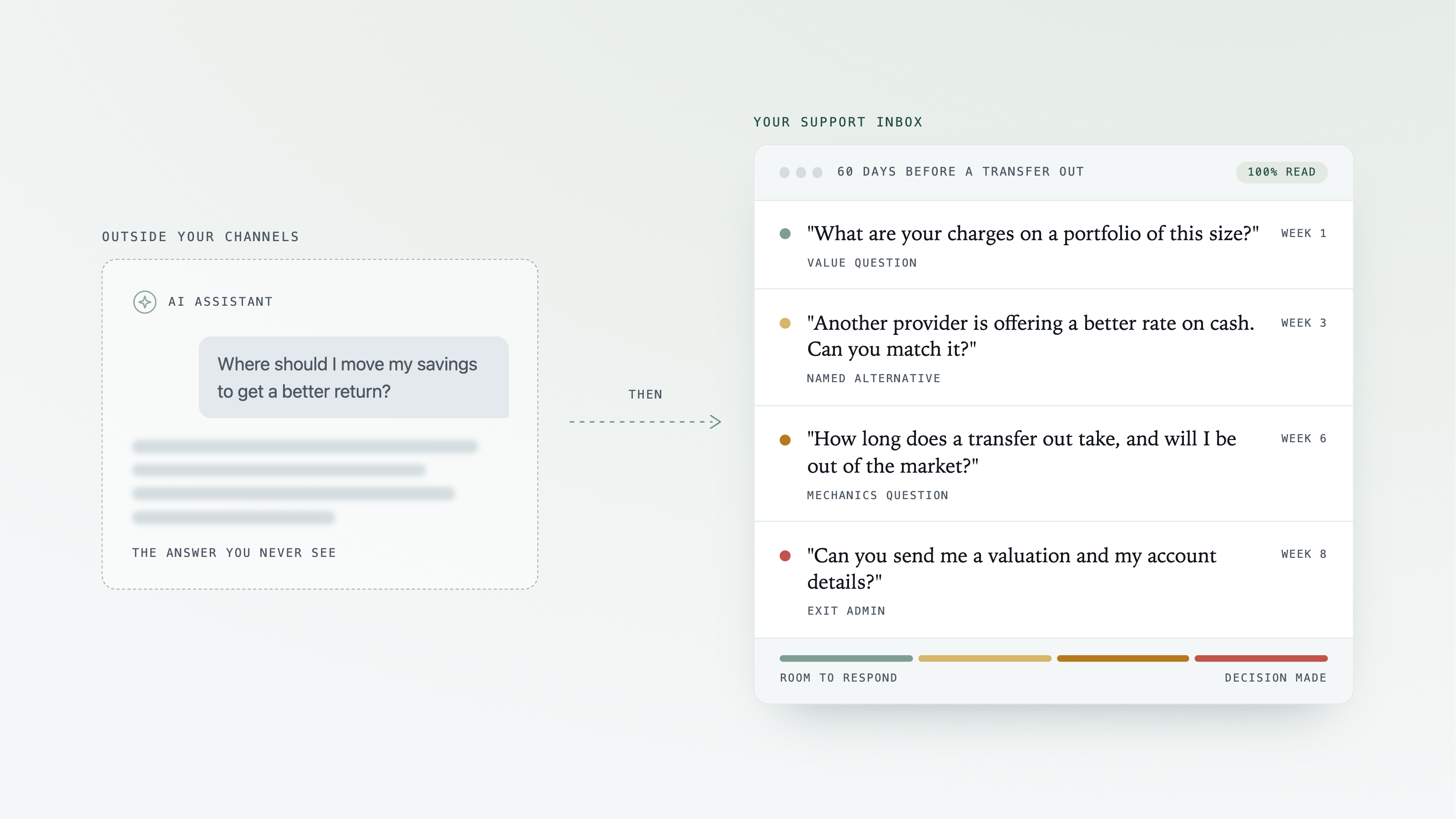
The comparison happens in the assistant. The reasons arrive in your inbox.
Your customers are asking AI where their money should go. You will never see that conversation. You will see the next one, with your own support team, when the customer asks about exit fees, transfer times or how to close the account.
That second conversation is the last touchpoint you still own. It often carries the reason for the move, in the customer's own words, before the transfer appears in your management information.
Isara reads every one of those conversations across your helpdesk. It shows what customers said in the weeks before a withdrawal or transfer out, including the providers they name when they ask.
The takeaway for customer experience leaders at investment, trading and savings platforms is simple:
- The decision is increasingly shaped somewhere you cannot see.
- The reasons still leak into the conversations you already have.
- The firms that read those conversations at scale will understand outflows. The rest will only report them.
How AI is changing the way customers decide to move their money
AI is now part of how ordinary people make savings and investment decisions. The numbers from the last six months point the same way.
What customers are already doing
- Using AI for money decisions. EY's Global AI Sentiment Survey, published in April 2026, found that 49% of 18,152 consumers in 23 countries had used AI to support savings and investment decisions in the previous six months. Among the roughly 1,000 UK respondents, the figure was 35%, as reported by Resultsense.
- Letting AI choose the provider. In the same EY survey, 21% used AI agents for financial product recommendations and 14% allowed AI to select financial services providers on their behalf.
- Using it often. McKinsey analysis reported by The Telegraph in September 2026 found that a quarter of UK consumers use AI tools for financial tasks at least once a month, rising to 59% among high income consumers.
- Being open to more. The FCA's Mills Review, published on 6 July 2026, found that one in five UK adults are already open to AI making financial decisions for them.
Why the stakes are rising for platforms
The same McKinsey analysis estimated that UK savers could move up to £700bn out of low or no return accounts on the advice of AI chatbots. It also put the number of UK adults holding £10,000 or more of investible assets entirely in cash at around seven million.
Moving is also getting easier. Industry figures published by TISA in July 2026 show that 87% of cash ISA transfers completed within seven working days in the first half of 2026, above the 85% industry target.
The regulator sees the same direction of travel. The Mills Review lists low switching among the long standing problems AI could help solve. It also warns that firms may struggle to show consumers understand products and decisions in AI mediated journeys, and favours continuous monitoring over point in time checks.
A fair counterpoint
Not everyone expects a flood. In June 2026, several US bank executives called fears of AI driven deposit flight overblown, noting that US direct banks have held a roughly stable 12% to 13% share of deposits despite paying higher rates.
That may well be right for the total. It does not change how the individual decision now gets made. Even if volumes stay flat, more of the reasoning behind each move happens outside your channels.
What your management information shows, and what it misses
Most platforms can already tell you:
- How much left, and when.
- Which products and account types lost assets.
- Which receiving providers the transfers went to.
Very few can tell you:
- What the customer asked before deciding.
- Which rate, fee or feature they compared you against.
- Whether the same question came up from fifty other customers that month.
What the conversation before a transfer sounds like
The comparison itself happens in an assistant. In the UK, the new provider usually starts an ISA or pension transfer, so the ceding firm can look passive. In practice, customers still contact you first. Support teams typically hear questions like these:
- "What are your charges on a portfolio of this size?"
- "How long does a transfer out take, and will I be out of the market?"
- "Can I move my ISA without losing this year's allowance?"
- "Another provider is offering a better rate on cash. Can you match it?"
- "Can you send me a valuation and my account details?"
Each one is ordinary on its own. Read together, across every conversation, they show why assets are leaving. Isara connects to Zendesk, Freshdesk, Intercom, HubSpot, Front and Gorgias, and reads 100% of those conversations rather than a sample, so the pattern is visible while there is still time to act.
What did your last 400 transfers out say first?
The assistant does the comparing in minutes. The transfer itself now takes days. The conversation with your team sits in between, and it is the only part of the journey you can still read.
We think of that window as a short sequence of signals. They rarely arrive in a neat order, but most outflows show at least one of them.
Four signals that come before a transfer out
- Value questions. The customer asks about charges, rates or performance, often quoting a number. This is usually the first sign that a comparison has started somewhere else.
- Named alternatives. The customer mentions another provider, a rate "seen elsewhere", or a product they were told is cheaper. This is the closest you will get to the assistant's answer.
- Mechanics questions. How long a transfer takes, cash or in specie, what happens to the ISA allowance, whether there are exit fees. The customer is now planning the move.
- Exit admin. Requests for valuations, statements or account details. The decision has usually been made.
The earlier the signal, the more room you have to respond. A value question can be answered. An exit admin request mostly cannot.
An illustrative model
The numbers below are hypothetical. They show how the analysis works, not what any real platform sees.
Imagine an investment platform that recorded 400 transfers out last quarter. It looks back at the 60 days of conversations before each one:
- 240 of the 400 customers, or 60%, contacted support at least once in that window.
- 90 of those 240 asked value questions, mostly about platform fees on larger portfolios.
- 45 named an alternative provider or quoted a cash rate from elsewhere.
- 60 asked mechanics questions about transfer times and ISA allowances.
- 45 only made exit admin requests.
Three things stand out in a model like this:
- Most of the signal arrives early. In this example, 135 of the 240 customers who made contact raised value questions or named an alternative before asking how to leave.
- The pattern clusters. The 45 who named alternatives might sit mostly in one cohort, for example customers holding large cash balances. That links directly to the seven million UK adults McKinsey estimates hold £10,000 or more in cash.
- It is invisible in a sample. If a team reviews 2% of conversations, it would read around five of those 240. That is not enough to see any pattern at all.
What this does not prove
A question about fees does not prove the customer left because of fees. A named competitor does not prove an AI recommended it.
What the analysis does show is what recurs, in which cohort and at what volume. That is enough to decide where to act: a pricing page, a cash rate review, a proactive message to a segment, or a better answer from the support team.
Isara is built for exactly this reading. It does not claim to know why each customer moved. It shows what customers said first, across every conversation, so the reason behind the movement your management information already reported is no longer a guess.
Three questions to ask your own data this week
- What share of last quarter's transfers out contacted support in the 60 days before?
- Which providers did customers name most often, and did that change after a rate or fee change?
- Which question did your team answer most often that might have been the last chance to keep the customer?
Frequently asked questions about Isara and transfers out
Can Isara show what customers said before they moved their money?
Yes. Isara reads every conversation in your helpdesk and lets you look back at the weeks before a withdrawal or transfer out. Churn Insights scores each conversation with a Conversation Risk score, and the Disengagement signal highlights customers whose behaviour suggests they are drifting away.
Can Isara tell me which competitors customers mention?
Yes. You can put a plain English question to Ask Isara, such as "Which providers did customers name before transferring out this quarter?" It answers from your own conversations, so you see the alternatives customers raise in their own words, not a survey estimate.
Does Isara claim that AI caused a customer to leave?
No. Isara does not claim causation. It shows what recurs, in which cohort and at what volume. Custom Filters let you slice the results by product, account type or any other field your helpdesk holds, so you can see where a pattern concentrates.
How quickly will my team see a new pattern?
Pulse surfaces changes in real time, so a sudden rise in fee or transfer questions after a pricing change does not wait for the monthly review. Scheduled reports can send the same view to your leadership team every week.
Does this help with Consumer Duty and the direction of the Mills Review?
It supports the evidence. The Mills Review favours continuous monitoring over point in time checks. Isara's Compliance Audits review 100% of conversations against the rules you set, so you can show how customers were informed when they asked about charges, transfers or exit fees.
What is coming next?
Isara is rolling out feedback on every signal, so your team can confirm or correct what it flags. That feedback will power an AI calibration section that suggests better instructions, with versioning so you can compare versions and see whether a change made a difference.