The conversations you are not reading are the ones a regulator will ask about
Why the conversations you never read are the ones that matter most to a regulator
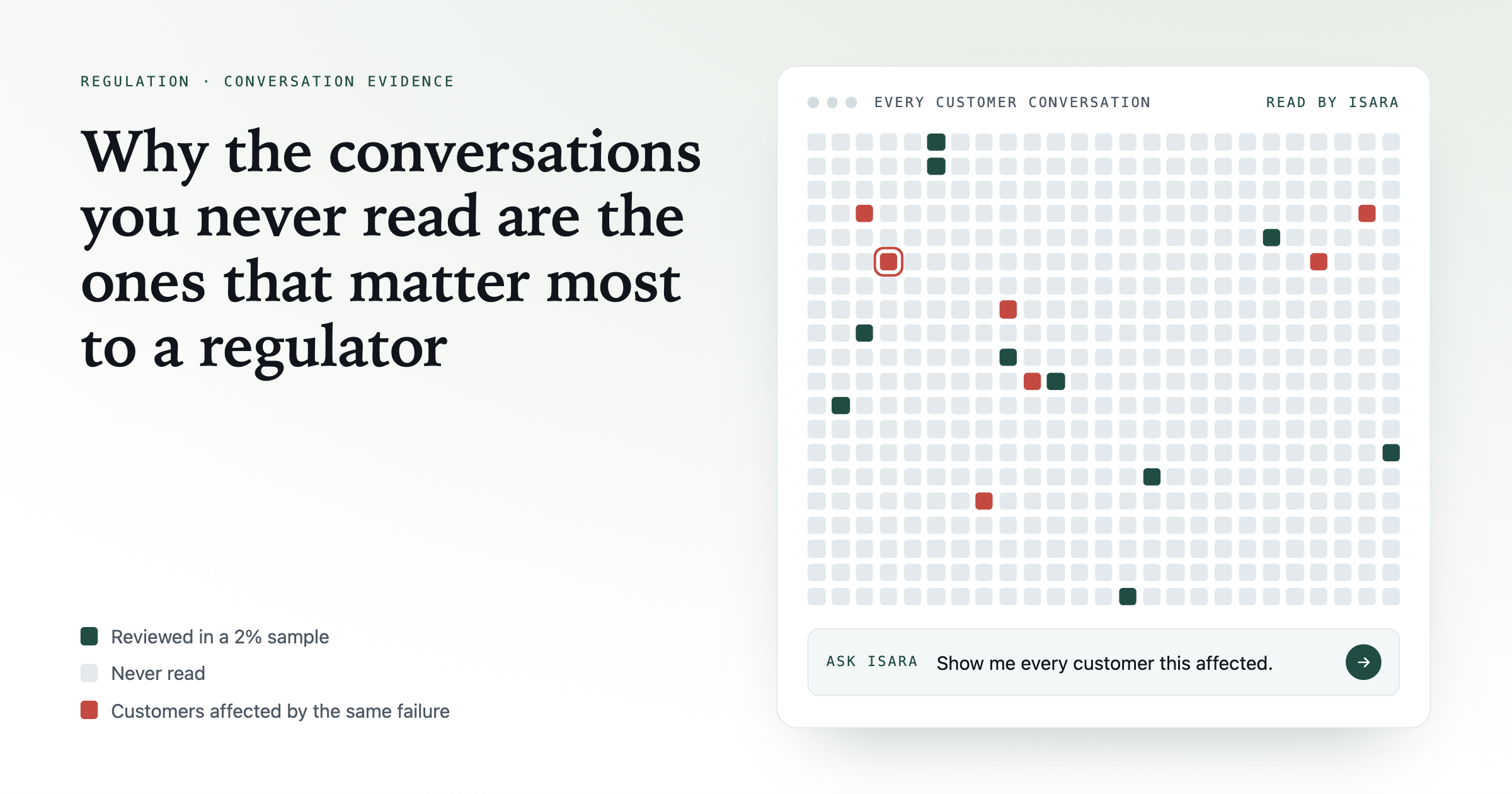
When a regulator asks about your customer conversations, it will not ask about the 2% your quality team reviewed. It will ask about the customer who complained, the customer who was harmed, and every other customer who had the same experience. Those are almost always conversations nobody in your business has read.
Isara, a conversation intelligence platform, exists to close that gap. It reads every customer conversation in your helpdesk, whether a person or an AI agent handled it, so that when the question comes, the answer is already in front of you rather than buried in a closed ticket.
This is not a single regulator's agenda. In the UK, the EU and the US, the direction of travel over the last six months has been the same: firms must be able to prove what happened in their customer conversations, including the ones AI handled on their behalf.
In short:
- Regulators are converging on one demand: show us what happened, who was affected and what you did about it.
- Using AI in customer service does not move accountability to the AI provider. The firm still owns the outcome.
- Sampling tells you whether a process works. It cannot tell you which customers it failed.
- The conversation itself is the evidence, which means every conversation needs to be readable, searchable and reviewable.
What regulators in the UK, EU and US now expect from customer conversations
Three developments since May 2026 point in the same direction. Each comes from a different legal tradition, and each lands on the same practical question for customer support, customer success and compliance leaders.
What did the FCA say about AI in October 2026?
On 19 October 2026 the Financial Conduct Authority published AI in financial services: good practice and areas for improvement. The FCA is clear that the examples do not create new requirements. They show what it considers good practice under rules that already apply, including the Consumer Duty and the Senior Managers regime.
The points most relevant to customer conversations, as summarised by TLT on 27 October 2026 and Latham and Watkins on 30 October 2026, are these:
- Records. Good practice firms kept records of consumer prompts, outputs, model versions, applied filters and escalation decisions, which supported monitoring, complaints handling and the investigation of challenged outcomes.
- Monitoring. The FCA favours continuous, outcomes focused monitoring of AI outputs, using dashboards with thresholds, spot checks and audit trails of AI interactions.
- Accountability. Firms can outsource AI services, but they remain responsible for them. Vendor assurances should be challenged and tested, not simply accepted.
- Vulnerability. Some firms placed too much confidence in a large language model's ability to spot text only indicators of vulnerability, particularly temporary ones.
Read together, the message is simple. If a customer challenges an outcome, the firm should be able to reconstruct the conversation and explain it.
What does the EU AI Act require now, after the Digital Omnibus?
The EU has delayed parts of the AI Act, but not the part that touches customer conversations first. The Digital Omnibus, finalised and in force according to Orrick on 29 July 2026, made these changes:
- High risk obligations for stand alone Annex III systems, a category that includes credit scoring, move to 2 December 2027.
- High risk obligations for AI embedded in regulated products move to 2 August 2028.
- The duty to tell people they are interacting with an AI system was left unaffected and applies from 2 August 2026, as Gibson Dunn noted on 27 May 2026.
For any business with an AI agent talking to EU customers, the transparency duty is already live. The longer deadlines buy time to build evidence, not permission to ignore it.
How are US insurance regulators approaching AI?
In the US, insurance is regulated state by state, and the NAIC Model Bulletin on the use of AI by insurers has become the common reference point. An adoption tracker based on the NAIC status map counted 27 states and the District of Columbia as adopters when it was verified on 3 November 2026.
The more telling development is what regulators are building to check it. At the NAIC Summer National Meeting in August 2026, the evaluation tool was renamed the AI Risk Evaluation Supplement and described as a resource for regulators examining insurers' AI systems in an examination context, according to Willkie on 25 August 2026.
Alston and Bird wrote on 21 September 2026 that insurers should be prepared not only to describe their AI governance programmes but to produce evidence of how their controls work in practice. The NAIC aims to consider the supplement for adoption at its Fall National Meeting.
The common thread for customer facing teams
Strip away the jurisdiction and the same three questions remain:
- What happened? Can you show the actual exchange, not a summary of policy?
- Who was affected? Can you find every customer who had the same experience, not only the one who complained?
- What did you do about it? Can you show when you noticed, how you escalated and what changed?
This is where Isara fits. Compliance Audits reviews conversations across Zendesk, Freshdesk, Intercom, HubSpot, Front and Gorgias for compliance breaches, with each finding linked to the transcript. The answer to the first two questions comes from the conversations themselves, not from a spreadsheet of sampled scores.
Why sampling answers the wrong question when a regulator calls
Most quality assurance programmes were designed to answer a management question: is the team broadly doing a good job? A regulator asks a different question: which customers were affected? The gap between those two questions is where firms get caught out.
A simple model of what a sample misses
Consider a hypothetical support operation handling 50,000 conversations a month, with a quality team reviewing 1,000 of them, which is 2%. Now assume a specific failure appears in 1 conversation in every 1,000. Perhaps an AI agent misstates a cancellation fee, or misses a customer who mentions a bereavement.
- Across the month, about 50 customers are affected.
- A random sample of 1,000 conversations would be expected to catch 1 of them.
- There is roughly a 37% chance the sample catches none at all, so the issue does not appear in any report that month.
- For a rarer failure, 1 in every 2,000 conversations, the chance of a clean sample rises to roughly 61%, while 25 customers are still affected.
The numbers are illustrative, but the mathematics is not. A sample is a good way to test whether a process works. It is a poor way to find the specific customers a regulator will ask about, because rare, serious failures are exactly what samples miss.
The FCA itself recognises good quality sample testing as a reasonable approach for smaller firms checking their systems. That is consistent with the point here. Testing a model and evidencing what happened to customers are different jobs.
Why AI agents make the gap wider
Human agents make mistakes one conversation at a time. An AI agent with a flawed instruction makes the same mistake in every conversation where that instruction applies, at whatever volume your traffic brings. That changes the risk profile in three ways:
- Scale. One error can reach thousands of customers before anyone reads a single affected conversation.
- Silence. Many affected customers never complain. They simply leave, or accept an outcome they should not have.
- Ownership. The FCA has been explicit that the firm, not the AI provider, answers for the outcome, and the NAIC's work on third party data and model vendors points the same way.
From closed ticket to queryable evidence
The shift we expect over the next two years is this: a closed ticket stops being the end of a conversation's useful life and becomes a piece of evidence that may be asked for later. Leaders who prepare for that tend to share a few habits:
- They read every conversation, so the population of affected customers can be identified rather than estimated.
- They treat AI handled and human handled conversations the same way in review.
- They keep the link between a finding and its transcript, so evidence can be shown, not described.
- They record what they did after a finding, so the response is as provable as the problem.
One honest caveat. Regulators such as the FCA also expect records that sit inside the AI system itself, such as model versions and applied filters. A conversation layer does not replace those. What it adds is the customer's side of the story, the part most likely to be quoted back to you.
This is the role Isara plays. It turns your full conversation history into something a compliance or customer leader can question in plain language, so that "show me every customer this affected" becomes a search rather than a project.
Frequently asked questions: Isara and conversation evidence for regulators
Does Isara review every conversation or a sample?
Isara reads every conversation it is connected to, not a sample. That is the point of the sampling model above: when a regulator asks which customers were affected, Isara can show the full population rather than an estimate based on the 2% someone happened to review.
How does Isara help prove what happened in a conversation?
Isara's Compliance Audits reviews conversations against the frameworks you choose and links every finding to the original transcript. When a customer challenges an outcome, your team can go straight to the exchange and see exactly what was said.
Can Isara review conversations handled by our AI agent?
Yes. Isara's AI Agents Focus looks at conversations handled by AI agents, flagging where an agent gave incorrect information, missed an escalation or failed to hand over to a person. Because accountability stays with your firm, these are the conversations most worth reading.
How do we find every customer affected by the same issue?
Ask Isara lets you ask questions about your conversations in plain language, and Custom Filters narrow the results to the customers and conversations you care about. Together they help answer the "who was affected" question that a sample cannot.
Is Isara specific to one regulator?
No. Isara does not depend on a single rulebook. Compliance Audits applies the frameworks you choose, which means the same conversation evidence can support teams answering to the FCA, to EU authorities under the AI Act or to US state insurance regulators.
What is Isara building next for oversight?
Isara's Agent and CSM Performance capability, now in development, will show how consistently each team member surfaces risks and escalates critical issues. For regulatory readiness, that adds the third question to the evidence: not only what happened and who was affected, but how your people responded.