What does the Bank of England and FCA AI survey mean for firms using AI agents with customers?
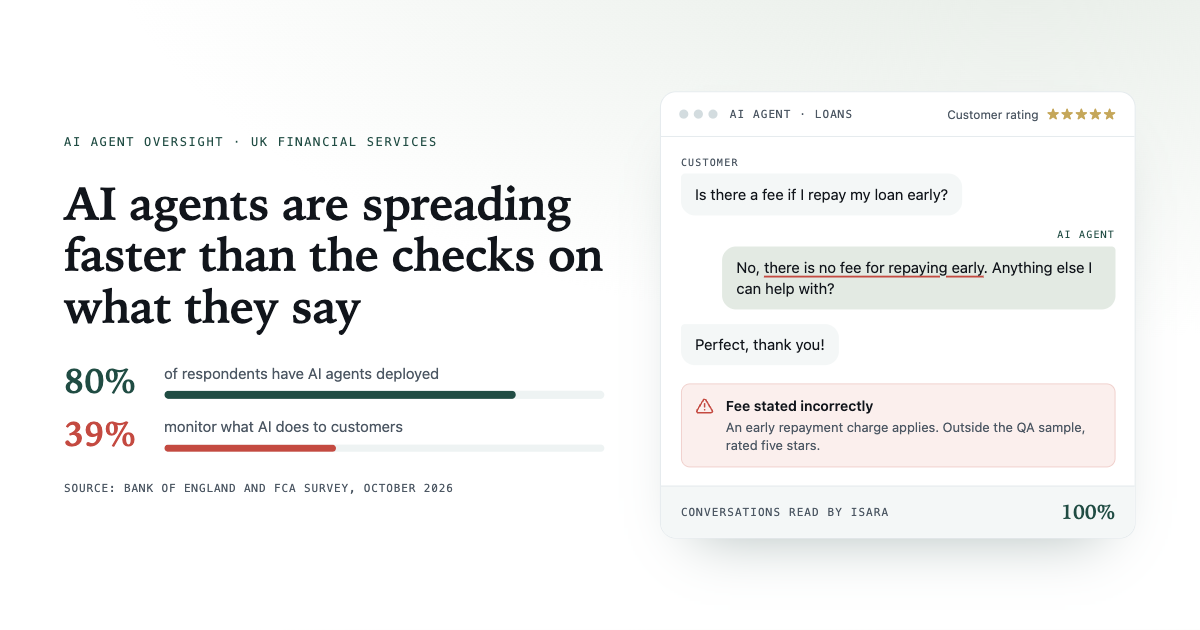
AI agents are spreading faster than the checks on what they say
The Bank of England and FCA survey of artificial intelligence in UK financial services, published on 26 October 2026, creates no new obligation for firms. What it does show is a clear gap. Most UK financial firms that responded already run AI agents, and a growing share plan to let those agents talk to customers. Yet fewer than half say they monitor what AI does to customers, and most lean on supplier assurances and contracts for how bought in systems behave.
At Isara, we read that as an oversight problem that sits inside customer conversations. When an AI agent answers a customer, the transcript is the most direct record of what the customer was actually told. Very few firms appear to be reading it systematically.
The report itself is careful. It is a descriptive summary of survey answers, not guidance, and it reflects the firms that took part rather than the whole sector. That is exactly why it is useful: it shows how firms describe their own controls, before anyone has told them what good looks like.
The short version:
- 80% of respondents have AI agents deployed, but only 2% give them broad autonomy.
- 16% already use agents for automated customer communications, and 34% will once planned deployments go live.
- Third party suppliers now account for 53% of the AI systems firms consider most material.
- Only 39% of respondents monitor customer impact, compared with 85% who monitor user feedback.
What the Bank of England and FCA survey actually found
The Bank of England and the FCA published Artificial intelligence in UK financial services 2026 on 26 October 2026. It drew 196 responses, 101 from larger firms and 95 from smaller ones, and 105 firms completed the full survey. Unless the report says otherwise, its figures come from those full responses.
Adoption is now close to universal among respondents. 86% reported using AI, up from 75% in 2024, although the regulators point out that the two surveys did not cover the same population of firms. Generative AI now makes up 56% of all reported AI systems.
Agents are common. Autonomy is rare.
80% of respondents reported AI agents currently deployed, and a further 14% plan to deploy them within 12 months. The report defines agents as AI systems that perceive and act on their environment, using tools to reach goals.
How much freedom those agents have matters more than whether they exist. The report sorts them into four levels:
- Decision support: the agent recommends, a human decides and acts. 80% of respondents run agents this way.
- Constrained execution: the agent acts within predefined limits and rules. 46%.
- Conditional autonomy: the agent acts independently but needs human approval for certain actions. 22%.
- Broad autonomy: the agent starts and completes actions with limited real time human involvement. Only 2%.
On paper, that is a cautious picture. Human review or approval for higher risk use cases was among the most common controls reported.
Customer communications is where agents are heading next
The cautious picture changes when agents face customers. 16% of respondents already use agents for automated customer communications, rising to 34% once planned deployments are included. If those plans go ahead, the share would more than double.
The wider category is larger still. 59% of respondents use some form of AI for customer or participant interaction and communications, rising to 71% with planned use. Customer communications is one of the few areas where a human cannot approve every output before it lands, because the whole point is speed and volume.
More of the important AI is now bought, not built
Third party suppliers provide 39% of all reported AI systems, up from 33% in 2024. For high materiality systems, the ones firms consider most significant, the share is 53%, up from 35%.
The way firms gain comfort over those systems is the striking part. For third party systems, respondents most often relied on vendor assurance and contractual arrangements, at 81%. Only 24% reported deep knowledge of third party AI systems, compared with 77% for systems built internally. 34% named limited transparency into third party AI as a major constraint.
What firms monitor, and what they do not
This is where the oversight gap becomes visible:
- 85% of respondents monitor user feedback.
- 72% monitor accuracy, precision or recall.
- 56% monitor robustness and safety.
- 39% monitor customer impact.
- 34% monitor risk metrics.
Controls before launch are strong. Pre deployment review, human approval and vendor due diligence were each reported by more than 90% of respondents. Ongoing monitoring, leakage testing and periodic review were each reported by only around half.
In other words, most firms check an AI system carefully on the way in, and far fewer keep checking what it does once it is live. Isara is built for that second job: reading live customer conversations after launch, not testing a model before it.
Read the numbers with care
The regulators flag their own limits, and leaders should repeat them when using these figures internally:
- The findings are evidence from participating firms, not a complete assessment of the UK financial sector.
- Percentages exclude firms that skipped a question, so the base can vary.
- Some questions drew small numbers. Only 48 firms answered on controls for vendor model updates. Of those, 25% said high materiality vendor updates always or usually flow into production automatically, a result the report says should be treated with caution.
- The 2024 and 2026 comparisons cover different groups of firms.
What the FCA said the week before
The survey did not arrive alone. On 19 October 2026, the FCA published good and poor practice examples for AI in financial services. The FCA states these examples do not create new requirements. They do show what it is looking for.
According to summaries by Clifford Chance and Lewis Silkin, the paper:
- Treats monitoring live outcomes as good practice, and flags monitoring only technical performance rather than customer or market outcomes as poor practice.
- Warns that human review can become a box ticking exercise, giving a false sense of comfort while the underlying weaknesses remain.
- States that firms cannot outsource responsibility to algorithms, technology vendors or large language models.
That follows the FCA's Mills Review, published in July 2026, which did not recommend a standalone AI regime. It relies on existing frameworks such as the Consumer Duty and the Senior Managers and Certification Regime, and notes that firms may find it harder to evidence how decisions were reached. In the survey, 63% of respondents said the Consumer Duty shapes how they adopt AI.
The assurance gap sits in the conversation transcript
Put the survey and the FCA paper side by side and one pattern stands out. Firms have three possible sources of evidence about what a customer facing AI agent is doing:
- The supplier's word: contracts, model cards and vendor assurance. This is what 81% rely on for third party systems, and it describes how the system should behave, not how it did behave with your customers.
- The customer's reaction: ratings, feedback and complaints. 85% monitor this. It captures what customers noticed, which is not the same as what happened to them. A customer given a wrong answer with confidence often has no reason to complain.
- The conversation itself: the full record of what the agent said, what the customer asked and where the exchange went wrong. This is the only one of the three that is independent of both the supplier and the customer's awareness.
Our view at Isara is that the third source is the one most firms underuse, and the one that maps most closely to monitoring customer outcomes rather than technical performance.
A worked example
The figures below are hypothetical. They only show the shape of the problem.
Imagine a lender whose bought in AI agent handles 20,000 customer conversations a month.
- The problem rate: 0.5% of those conversations contain something that matters. A fee stated wrongly, a vulnerability cue missed, or a complaint the agent did not recognise as one. That is 100 conversations a month.
- The sample: the quality team reviews 2% of agent conversations, or 400 a month. On average, that sample will contain two of the 100 problem conversations.
- The feedback: most of the affected customers do not realise anything went wrong, so ratings stay healthy.
- The update: mid month, the supplier updates the underlying model. The agent starts phrasing a key condition differently. Neither the sample nor the feedback is large or fast enough to show the change.
Every individual control in that example is reasonable. Together, they leave a firm confident in a system it cannot actually see. Reading every conversation does not remove the need for human judgement, but it changes what humans spend their time on. Instead of hoping the sample catches a problem, reviewers start from the conversations most likely to contain one.
What we expect over the next year
These are predictions, not findings:
- As customer communication agents move from 16% towards the 34% planned, the volume of agent conversations will outgrow sampling based quality assurance in many teams.
- Firms will increasingly be asked to show evidence of how an agent behaved with real customers, not only evidence of how it was tested before launch.
- The question for third party AI will shift from "what does the supplier promise?" to "what do our own records show?", especially after supplier model updates.
Where to start
You do not need a new programme. You need a view of the conversations you already have.
- List every AI agent that talks to customers, including those inside supplier products.
- Confirm where those conversations are stored, and whether anyone reads them beyond a sample.
- Define the outcomes that matter for each agent: correct information, fair treatment of vulnerable customers, complaints recognised and routed.
- Track those outcomes over time, and check them again after every supplier update.
This is the loop Isara is designed to support. Because Isara reads 100% of conversations, it can show how your AI agents are behaving across all of them, not only the ones that were sampled or rated.
AI agent oversight and Isara: frequently asked questions
Does the Bank of England and FCA survey mean we have to monitor our AI agents?
No. The survey is a descriptive summary of how firms use AI, and the FCA's good and poor practice examples state that they do not create new requirements. What both show is where firms' controls are thinner, such as monitoring customer impact. Isara helps you see how AI agents behave in real customer conversations, which is useful evidence whatever framework your compliance team works to.
How does Isara monitor AI agents that we bought from a supplier?
Isara reads the conversations, not the model. If your supplier's agent conversations reach your helpdesk, Isara can read them alongside conversations handled by people. AI Agents Focus shows how your AI agents are performing, so you can see behaviour that a vendor assurance cannot show you.
We already review a sample of conversations. What does Isara add?
Isara reads 100% of conversations, so problems that are rare but serious are surfaced for review instead of left to chance. Compliance Audits identify possible compliance breaches in conversations, and Escalation and Early Warning Signals spot heated conversations before they escalate. Your reviewers keep the judgement. They simply start from the conversations most likely to need it.
How would we notice a change after a supplier updates its model?
Look at trends, not single conversations. Isara's Customer Frustration Watch shows how frustration evolves over time, Areas of Concern show which issues are rising, and the Inconsistencies metric highlights where answers are not consistent. A shift in any of these after a supplier update is a signal worth investigating.
Our ratings look fine. Why would we need more than customer feedback?
Feedback tells you what customers noticed. Many customers never notice a wrong answer. Isara's Comprehensive Satisfaction Insights and Predicted CSAT go beyond the customers who leave a rating, so you can see how conversations went for everyone, not only the people who replied to a survey.
Can our compliance team get answers without building reports?
Yes. Ask Isara lets your team ask questions about your conversations in plain language, and scheduled reports can send a regular view of AI agent behaviour to the people who need it. Recommendations (AI Boosts) can be handed off to Jira, so the team that owns an agent gets the fix in its own backlog.
What is coming next?
Agent and CSM Performance will extend performance tracking across support agents and Customer Success Managers, including how they surface risks and escalate critical issues. That gives leaders one view of how people and AI agents handle customers side by side.
Which helpdesks does Isara work with, and how do we try it?
Isara connects to Zendesk, Freshdesk, Intercom, HubSpot, Front and Gorgias. Onboarding is self serve, and you can use the product free for a month to see how your own AI agents are behaving across every conversation.