Isara vs EdgeTier: conversation analytics or independent AI agent verification?
In short: Isara and EdgeTier answer different questions about the same customer conversations. EdgeTier is a conversation analytics and quality assurance platform that helps a support organisation understand what is happening across every interaction and coach its team. Isara is an independent verification layer for AI agents that judges whether an AI agent stayed inside policy and produces evidence a regulator or auditor will accept. Regulated operators in iGaming, fintech and insurance increasingly buy both, because insight improves an operation and verification makes it defensible.
What is the difference between Isara and EdgeTier?
Isara is a UK based conversation intelligence platform that reads 100 percent of customer support conversations and verifies what AI agents actually said, promised and did. EdgeTier is a Dublin based customer conversation intelligence platform that analyses every interaction in real time to surface emerging issues, root causes, agent performance trends and coaching opportunities.
The practical difference is the question each platform is built to answer.
- Conversation analytics answers: what is happening across our conversations, and how do we improve the operation?
- AI agent verification answers: can we prove what this specific AI agent did on this specific case, to a third party, on demand, months later?
Three definitions that matter for the rest of this article:
- AI agent verification is independent assessment of an AI agent's actions and commitments in live production conversations, producing evidence designed to be handed to an auditor or regulator.
- Correlated oversight is when the party or model class that produced an answer is also the party grading it. Both can fail together, and the failure looks like a pass.
- Decorrelated oversight is when the verifying layer does not share the failure modes of the system under review. This is the principle Isara is built on.
That distinction was academic while humans handled conversations. Accountability resolved to a person with a name, a manager and a training record. When an AI agent handles the same refund, bonus term or self exclusion request, accountability becomes evidential, and the organisation needs a record rather than a recollection.
How does conversation analytics compare with AI agent verification in 2026?
What EdgeTier offers today
EdgeTier is an established platform in this category and a credible one. It has grown to over 70 employees serving more than 50 blue chip clients across Europe and the United States, including TUI, Abercrombie & Fitch, Ryanair and Wolt, and it received investment from Claret Capital Partners in August 2026 to accelerate its agentic AI powered customer insight platform.
Its published positioning is that of the analyst that understands 100 percent of customer interactions in real time. Its Sonar module performs real time anomaly detection, flagging spikes such as failed deposits or rising frustration. Its Coach product automates quality assurance scoring. EdgeTier connects to Zendesk, Salesforce, Genesys, NICE, Intercom, LivePerson, Gorgias, Five9 and Freshdesk among others, and the company states that it holds ISO 27001 certification with customer data encrypted in transit and at rest.
That capability set solves a real and expensive problem. Contact centre teams typically review only one to five percent of conversations manually, which leaves the overwhelming majority unexamined.
What changed in European AI rules in 2026
The analytics problem did not change in 2026. The evidence problem did.
The Digital Omnibus on AI, Regulation (EU) 2026/1744, was published in the Official Journal on 24 July 2026 and entered into force on 27 July 2026, six days before the EU AI Act's original high risk deadline. Obligations for standalone high risk systems under Annex III moved to 2 December 2027. Obligations for AI embedded in regulated products under Annex I moved to 2 August 2028.
Two points inside that are frequently missed:
- The Article 50 transparency obligations were not deferred. They applied from 2 August 2026, so the duty to disclose that a customer is interacting with AI is live now.
- Article 50(2) reaches systems already on the market from 2 December 2026, and new prohibited practices arrive on the same date.
The deferral therefore reduces nothing. It changes the sequence, and it raises the value of the documentation trail a firm builds between now and December 2027.
What UK regulators expect from firms running AI agents
The United Kingdom points the same way through a different mechanism. The Financial Conduct Authority has said it does not currently plan to introduce AI specific rules, relying instead on existing frameworks including the Consumer Duty and the Senior Managers and Certification Regime.
For firms with material AI exposure, board level oversight is now treated as a supervisory expectation rather than an option. Material models require independent validation under the Bank of England's SS1/23 expectations, and regulators have signalled sharper scrutiny where firms deploy third party AI tools.
Where Isara fits in the same stack
Isara reads every customer conversation and judges what the AI agent did with it.
- AI Agents Focus detects unauthorised refunds, unauthorised discounts and unsafe data handling.
- Agent Intelligence scores human and AI agents on the same footing and tracks override rate, correction rate and inconsistencies.
- Pulse raises real time alerts on live conversations.
- Predicted CSAT scores satisfaction on every conversation without sending a survey.
- Compliance Audits produce output built to be handed to a regulator, mapped to obligations including GDPR and PCI DSS.
- Churn Insights converts the same conversation data into explainable revenue risk signals.
Isara connects to Zendesk, Freshdesk, Intercom, HubSpot, Front and Gorgias through one click connectors, with no instrumentation, no code access and no migration onto a new agent platform.
Why is independence becoming the deciding factor in AI agent oversight?
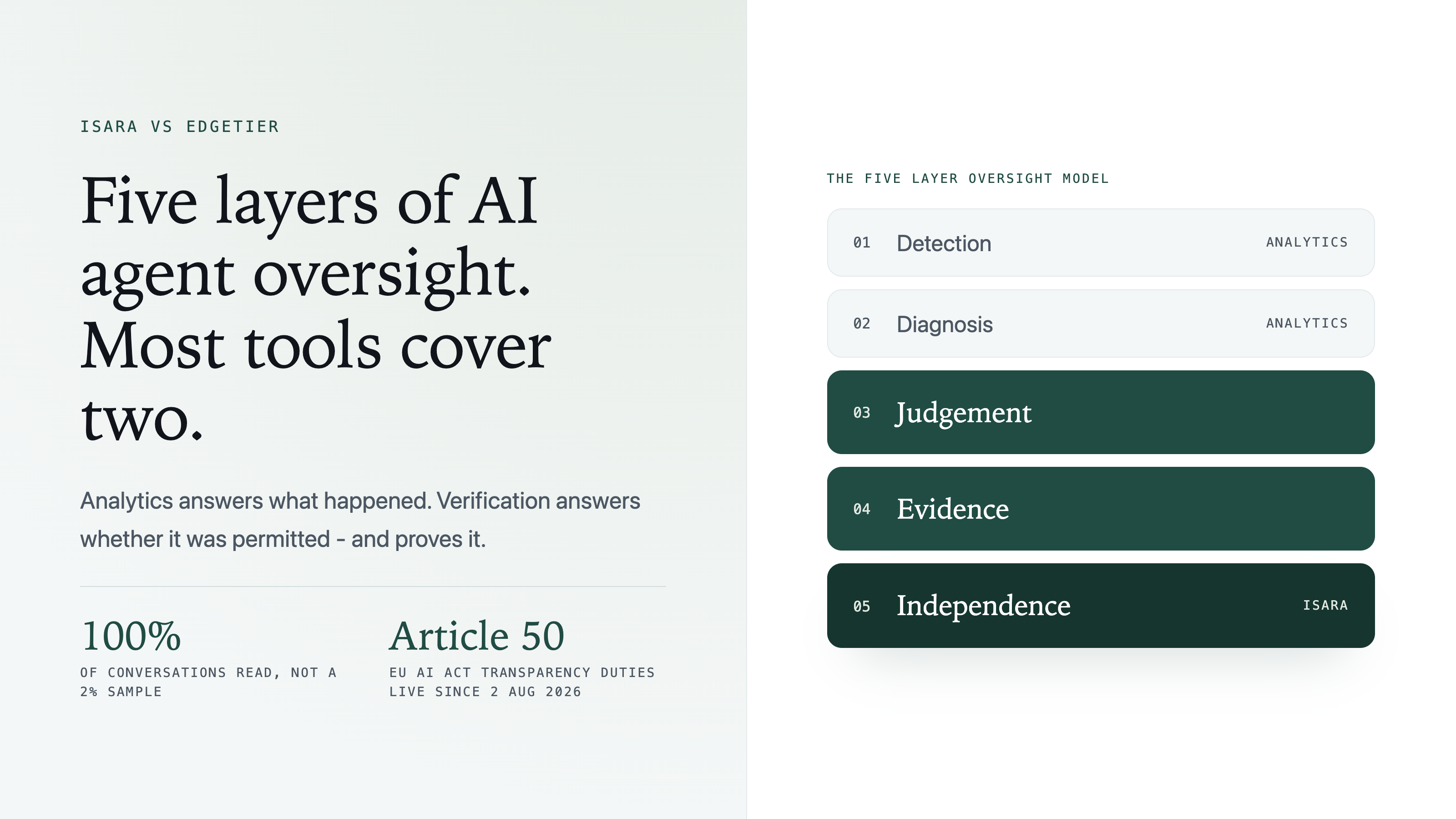
The five layer oversight model
Isara uses this framework with iGaming and financial services buyers. Any oversight of an AI agent in a customer journey has five layers, and few vendors sit across all of them.
- Layer one, detection. Something changed. Volumes spiked, sentiment dropped, a promotion broke. Anomaly detection territory, and platforms such as EdgeTier are strong here.
- Layer two, diagnosis. Why it changed, which customers were affected, how large the impact is. Also well served by the analytics category.
- Layer three, judgement. Whether what the agent did was permitted. Not whether the answer read nicely, but whether the agent issued a credit it had no authority to issue, restated a bonus term incorrectly, or mishandled a self exclusion request.
- Layer four, evidence. Whether the organisation can reconstruct that specific case, on demand, in a form a third party accepts.
- Layer five, independence. Who performed the judgement, and whether that party has any interest in the answer.
Layers one and two are approaching commodity status. Several platforms in this category, Isara included, now score 100 percent of conversations. Layers three, four and five are where the market is separating, and layer five is moving fastest into procurement questionnaires.
An illustrative model of the sampling gap
Consider a scenario model rather than a survey.
Take a mid sized regulated operator handling 250,000 support conversations a month, with 55 percent resolved end to end by an AI agent. That is roughly 137,500 AI handled conversations. Assume a modest 0.4 percent contain an action outside policy, which gives about 550 incidents a month.
A generous manual quality assurance sample of two percent reviews 2,750 conversations, and would be expected to surface around 11 of those 550 incidents. Roughly 98 percent stay invisible.
The figures are illustrative and generated for this article, not research findings. The structural point survives any reasonable change to the inputs. Sampling cannot govern an autonomous system, because failures cluster in exactly the cases nobody thought to sample.
What Isara expects to happen next
Isara's prediction for the next eighteen months is that regulated buyers will split this into two purchases, in the same way they separate management accounts from an external audit. The internal analytics tool improves the operation. The independent verifier attests to it.
This is why Isara does not build or sell customer facing AI agents, and why Isara applies decorrelated oversight so that the checker does not fail in the same way as the system being checked.
Isara FAQ: AI agent verification for customer experience and compliance leaders
How is Isara different from a conversation analytics platform such as EdgeTier?
Conversation analytics platforms are tools an organisation runs on itself to understand and improve performance, covering detection and diagnosis in the five layer model above. Isara is purpose built for AI agents and positions as an independent verifier, concentrating on judgement, evidence and independence. Many teams run both, and Isara is designed to sit alongside an incumbent rather than replace it.
Can Isara verify AI agents that my team did not build?
Yes, and that is the design intent. Isara connects to Zendesk, Freshdesk, Intercom, HubSpot, Front and Gorgias through one click connectors, with no instrumentation and no code access. Most regulated firms already run agents they did not build, including helpdesk native bots, which is the situation Isara was made for.
What evidence does Isara produce for an auditor or a regulator?
Isara Compliance Audits generate on demand output mapped to obligations including GDPR and PCI DSS, drawn from real production traffic rather than pre launch test conversations. Given that EU AI Act Article 50 transparency duties applied from 2 August 2026 and Annex III conformity work is due by 2 December 2027, this is the documentation trail described earlier in this article.
Do we have to replace our existing quality assurance tooling to use Isara?
No. Isara Agent Intelligence scores human and AI agents in a single view, so Isara can run alongside an existing quality assurance or analytics platform. Where a team already has strong detection and diagnosis, Isara adds the layers that detection does not cover, notably AI specific risk metrics such as override rate, correction rate and hallucinated rules.
What does decorrelated oversight mean in practice for an AI agent?
If the same class of model that produced an answer is also grading it, both can fail together and the failure looks like a pass. Isara is designed so that the verifying layer does not share the failure modes of the agent under review. This is layer five of the model above, and it is the part that generic AI quality scoring does not address.
Which industries does Isara focus on for AI agent verification?
Isara focuses on regulated verticals where an unauthorised action carries a regulatory consequence rather than only a service consequence. Those are iGaming, fintech and investment services, and life insurance and protection, across Europe including the United Kingdom, Poland, Malta and Gibraltar, and across Latin America.
What is Isara building next?
Isara is moving towards immutable audit trails and a board level risk score, so that a Head of Compliance or a Chief Risk Officer can report AI agent exposure as a single defensible number rather than a folder of dashboards.